.png?width=768&height=336&name=fullfillingcareers-blog2-rippleeffects-BLOG%20(1).png)
Career Fulfillment, Wellbeing, and Life Satisfaction

What makes a career truly transformative? The business media might suggest it's all about finding your bliss, achieving perfect work-life balance, or loving what you do so much that it never feels like work. But career fulfillment isn't about constant enjoyment or a single dream job. It's a deep sense of satisfaction that comes from doing work aligned with your needs, skills, and values. And new research fromPerceptyx reveals how that satisfaction creates ripple effects that touch every aspect of our lives.
In our previous exploration of career fulfillment, we identified 10 key attributes that define truly satisfying careers, from Career Pride and Purpose to Growth & Development and Organizational Satisfaction. But understanding these attributes is just the beginning. The data show that developing multiple career fulfillment attributes simultaneously produces significantly stronger outcomes for both employees and their organizations.
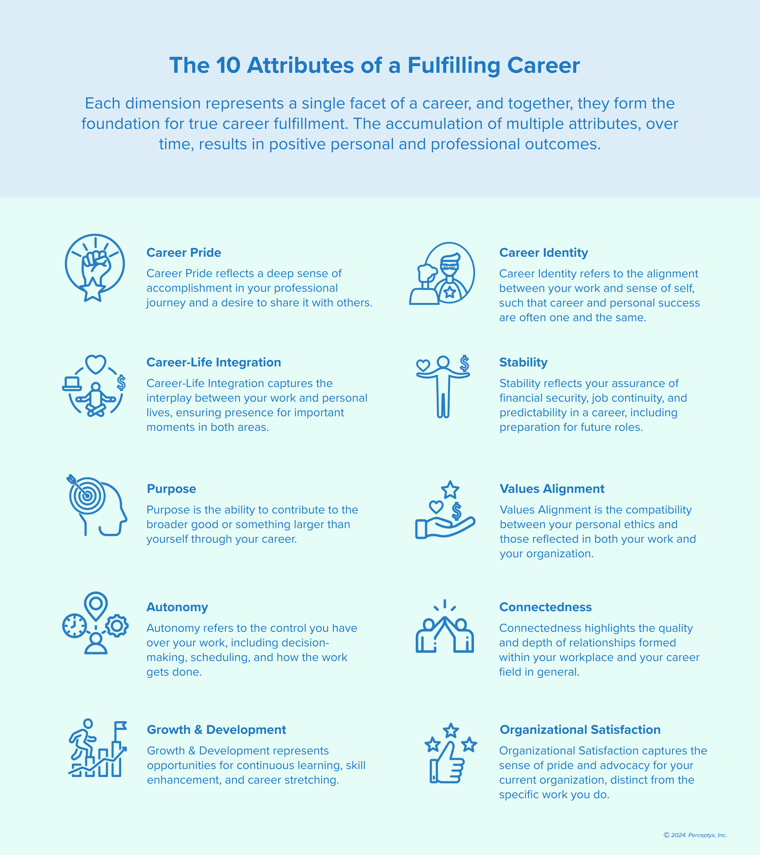
How does career fulfillment reach beyond job satisfaction?
A fulfilling career is about far more than just liking the work you do or being happy where you do it. For individuals, a fulfilling career improves their day-to-day experience, reduces stress, and fosters long-term life satisfaction. The effects are also felt by the organizations that employ them since fulfilled employees are more productive, innovative, and loyal. Importantly, career fulfillment is a shared responsibility. It requires organizations to invest in connecting employees to the impact of their contributions, and it requires employees to identify and communicate what they need to thrive. Our study identified three important areas of our lives where career fulfillment matters: Day-to-Day Health and Well-Being, Organizational Impact, and Long-Term Life Satisfaction.
How does career fulfillment shape day-to-day health and well-being?
These outcomes reflect how career fulfillment shapes an individual's daily life. We measured current stress levels and improvements in mental and physical health compared with one year ago. HR leaders must prioritize the career dimensions that reduce stress and improve mental and physical health — and the data show Career Identity, Stability, and Purpose are the strongest predictors of those outcomes.
Among the 10 career attributes, Career Identity, Stability, and Purpose emerged as key drivers of individual health outcomes. Employees who score highly in Career Identity are 1.6x more likely to say their physical health has improved over the prior year and 1.4x more likely to report improvements in their mental health. Similarly, those scoring highly in the Stability and Purpose dimensions are also more likely to say their physical and mental health has improved in the past year.
When it comes to managing stress, slightly different attributes take precedence. The top predictor of low stress is Career-Life Integration, with high-scoring employees 1.8x more likely to report low levels of stress. That's followed by Organizational Satisfaction (1.3x) and Connectedness (1.2x).
How does career fulfillment drive organizational performance?
These measures represent an individual's contributions to the workplace and include improvements in quality and quantity of work, employee engagement, and whether individuals are actively seeking new job opportunities. When employees lack social connection or opportunities for growth, they are among the most likely to feel unfulfilled at work. That's why the attributes linked to organizational contribution in our research matter so much for both employees and the organizations employing them.
Growth & Development and Connectedness were unique drivers of organizational contribution. Employees experiencing a career rich in Growth & Development are twice as likely to say their productivity and quality have increased since this time last year. Connection to co-workers also emerged as a unique predictor of workplace contribution, making them 1.9x as likely to have increased their productivity and quality of work.
How does career fulfillment connect to long-term life satisfaction?
A fulfilling career has a lasting influence, shaping how individuals view their lives as a whole. We assessed this using measures such as overall life satisfaction and whether employees would choose the same career path again if they were just starting out.
When it comes to the life satisfaction outcomes researchers studied, two key career fulfillment attributes stood out: Career Pride and Organizational Satisfaction. The data show for long-term life satisfaction, the career you choose is as important as the organization you choose to work for.
Employees who score highly in Career Pride are 1.3x more likely to say that, when looking back, they are satisfied with their lives and 1.6x more likely to say they would choose the same career if they had to do it over again. Those scoring highly in Organizational Satisfaction had similar results.
Why do combined career attributes produce stronger outcomes?
While it's clear that each dimension is related to important outcomes for the individual and the organization, no single dimension is sufficient. The data show that accumulating multiple career fulfillment attributes produces a compounding effect: employees with eight or more attributes report significantly better health, productivity, and life satisfaction outcomes than those who excel in only one or two.
Using cluster analysis, researchers found that while the effect of career fulfillment is generally linear, there are crucial tipping points. The 39% of employees with 3 or fewer attributes are struggling across the board on key outcomes, while the 29% who have amassed 8 or more attributes are prospering.
Prospering employees are 2.6x more likely to report satisfaction with their lives and 3x more likely to say they would choose the same career all over again. In their day-to-day lives, they are 2.8x more likely to say their physical health is better and 2.5x more likely to say their mental health has improved in the last year.
Prospering workers are also a boon to their employers. They are 1.6x more likely to say their productivity and quality of work have increased in the past year. Nearly 2 in 3 workers with fewer than three attributes are actively seeking a new role — 1.5x that of their prospering counterparts.
In each case, the odds of success on the outcomes for individuals high in 8 or more attributes were nearly twice as high as the single most predictive attribute alone. Employees who accumulate eight or more career fulfillment attributes are nearly twice as likely to thrive on key outcomes compared to those who score highly in just one attribute.
So what does this mean in practice? For employees, start by identifying which attributes your current role already supports, then focus on building the one or two that are missing. For organizational leaders, consider implementing behavioral activation strategies and regular career check-ins that help employees track which attributes they're developing and what support they need next. For a full breakdown of these strategies, explore our research-based blueprint for leaders and employees.
Frequently asked questions
What does career fulfillment mean?
Career fulfillment is the sense of satisfaction that comes from work that fits your skills, values, and sense of purpose. It goes beyond liking your job or earning a good salary. Perceptyx research identifies 10 specific attributes — including Career Pride, Purpose, Stability, and Career-Life Integration — that together determine how fulfilled an employee feels in their role. No single attribute is enough; the more attributes an employee builds, the stronger the outcomes across health, productivity, and long-term satisfaction.
How does career fulfillment affect employee health?
Career fulfillment has a direct, measurable effect on physical and mental health. Employees who develop strong Career Identity report improved physical and mental health year over year. Career-Life Integration serves as a powerful driver of low stress, while Organizational Satisfaction and Connectedness also contribute to lower stress, creating a holistic foundation for employee wellbeing that extends far beyond the workplace.
How many career fulfillment attributes do employees need to thrive?
Perceptyx research points to a clear threshold: employees who develop a majority of the 10 career fulfillment attributes are classified as "prospering" and report significantly better outcomes across life satisfaction, physical health, and productivity. On the other end, employees with only a few attributes struggle across every key outcome and are far more likely to be actively seeking a new role. Building more attributes consistently improves results; no single attribute delivers the same effect on its own.
What is the difference between job satisfaction and career fulfillment?
Job satisfaction describes how an employee feels about their current role — things like pay, workload, and their relationship with their manager. Career fulfillment operates at a broader level. It reflects how well a person's work aligns with their identity, sense of purpose, and long-term goals. Research shows that long-term life satisfaction depends on both the career a person chooses and the organization they work for — two distinct factors. An employee can be satisfied with their job today while still lacking the Career Pride, Purpose, or Career-Life Integration that drives lasting fulfillment.
Can employees build career fulfillment attributes on their own?
While employees play an active role in their own career fulfillment, they can't do it alone. Building attributes like Growth & Development, Connectedness, and Organizational Satisfaction requires organizational support through structured development programs, mentorship opportunities, and a culture that values employee contributions. Employees can start by identifying which attributes their current role already supports and communicating what they need to develop others. The most successful outcomes emerge when both employees and organizations share responsibility for creating the conditions where fulfillment can flourish.
Why do some employees struggle to achieve career fulfillment despite having good jobs?
Having a "good job" on paper — competitive pay, benefits, job security — doesn't automatically translate to career fulfillment. Employees may lack connection to the broader purpose of their work, feel disconnected from colleagues, or see limited opportunities for growth despite performing well. Many employees possess only a few career fulfillment attributes, meaning they're missing critical elements like Career Pride, Purpose, or Career Identity that give work deeper meaning. Organizations that focus solely on transactional job features without addressing these deeper psychological and social needs will continue to see employees struggle, even when traditional job satisfaction metrics look positive.
How can organizations measure whether employees are prospering or struggling?
Organizations can assess career fulfillment by measuring employee experiences across all 10 attributes through regular pulse surveys, career check-ins, and engagement assessments. Rather than relying on single-point metrics like annual engagement scores, leaders should track how many attributes each employee is developing over time and identify patterns across teams and departments. When organizations notice clusters of employees with limited attributes, that's a clear signal to intervene with targeted support before turnover accelerates. The goal isn't perfection across all attributes immediately, but rather creating visible momentum that helps employees move from struggling to stable, and from stable to prospering.