
New Data on Retail Employee Experience: Enablement, Managers, and Well-Being

Retail organizations are heading into 2026 under familiar pressure. Customer expectations remain high, labor availability is uneven, and leaders are expected to deliver consistent experiences with lean operating models. Perceptyx benchmark data drawn from organizations in the retail sector shows that employees generally understand what their roles require and feel aligned with the customer mission. At the same time, gaps in enablement, manager capacity, and well-being create friction that makes this work harder to sustain.
These results reflect responses across retail organizations as a whole. While frontline roles make up a large share of the retail workforce, the patterns here speak to the broader employee experience within retail environments. The story that emerges is not about isolated issues, but about how expectations, support, and workload combine into a single system.
What Do Engagement Levels Tell Us About Retail Employees?
At a headline level, engagement across retail organizations appears relatively stable, though it consistently trails overall benchmarks. We observed that 78% of retail employees say they are proud to work for their company, and nearly the same proportion intend to stay with their organization over the next year. Additionally, 77% report a sense of personal accomplishment in their work.
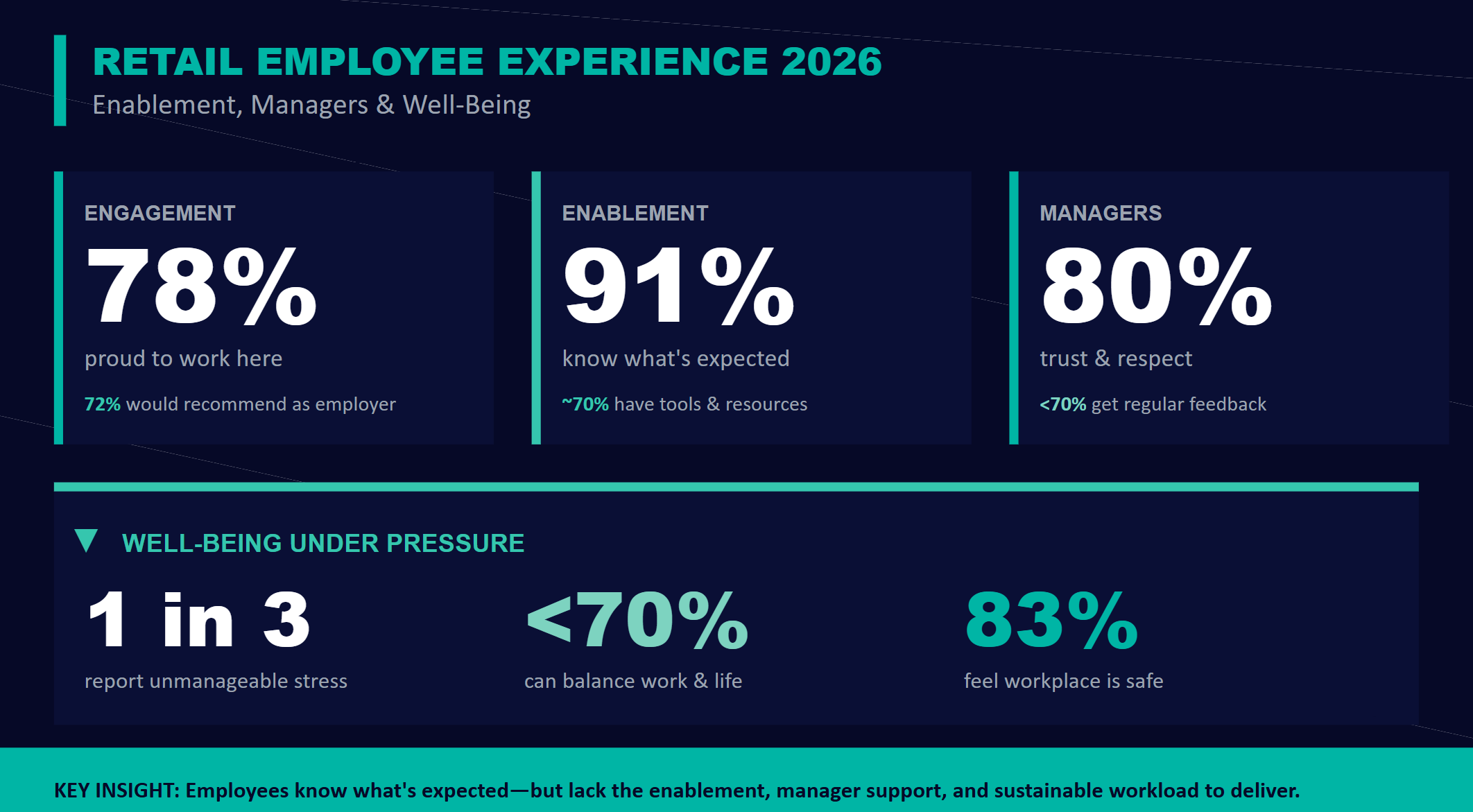
Advocacy is where the experience begins to show strain. Only 72% would recommend their organization as a great place to work. In an industry that depends heavily on reputation to attract and retain talent, that gap matters. Engagement has not collapsed, but it is increasingly conditional on whether employees feel supported in doing their jobs well.
How Does Enablement Connect Expectations to Reality?
The data makes it clear that retail employees are not confused about what success looks like. 91% of employees say they know what is expected of them at work, and 83% believe their organization is committed to exceeding customer expectations. Retail organizations have done well at setting standards and reinforcing customer focus.
Previous Perceptyx research shows why these behaviors matter. When employees feel valued and connected to customer outcomes, they are dramatically more likely to say customers find it easy to do business with their organization and that problems are resolved quickly.
Where the experience becomes less consistent is in the systems that support execution. Only about 7 in 10 employees feel appropriately involved in decisions that affect their work. Similar proportions say they have the tools, systems, authority, and processes needed to do good work. Confidence drops further when employees consider whether their teams have enough resources, with just two-thirds saying staffing and financial support are sufficient.
This gap between clarity and enablement is critical. Employees are being asked to meet high expectations without always having the capacity or flexibility to meet them. Highly engaged employees are notably more favorable on these enablement measures, reinforcing that engagement in retail reflects whether work feels doable, not simply whether employees are committed.
Why Do Managers Sit at the Center of the Retail System?
Managers play a pivotal role in translating organizational intent into daily experience, and the data suggests many retail managers are providing strong interpersonal support. Around 8 in 10 employees feel comfortable discussing concerns with their manager, believe expectations are clearly communicated, and feel treated with respect.
At the same time, managers appear constrained in their ability to coach and develop employees consistently. About three-quarters say their manager supports their skill and career development, and under 70% report receiving regular performance feedback. This matters in retail roles where learning, adaptability, and emotional labor are ongoing requirements.
Highly engaged employees are far more likely to experience managers as supportive coaches, while others experience management as more transactional. Research on manager effectiveness shows that employees working under their best managers report manageable workplace stress, reasonable workloads, and better work-life balance. Those with substandard managers are 2.5x less likely to be fully engaged.
Retail managers are acting as stabilizers in the system, but without sufficient time, staffing, and tools, that role is difficult to sustain at scale. More than half of frontline leaders perceive their challenges as mounting, and 56% of managers are responsible for producing individual work alongside their people management duties.
What Does Well-Being Reveal About System Misalignment?
The cumulative effect of high expectations and uneven enablement shows up most clearly in well-being. Fewer than 7 in 10 retail employees say they can balance work and personal life, feel their workload is reasonable, or believe stress levels at work are manageable. Among those items, stress is a particular pain-point, given that more than a third of employees reported it being unmanageable.
Perceptions of safety are much stronger, with nearly 83% saying their workplace is safe, and 70% believe their organization cares about their health and well-being.
Other Perceptyx research focused on frontline workers helps explain this tension. Retail workers face unique pressures: 61% have dealt with unruly customers (the highest rate across all industries), and 81% report burnout. Difficult customer interactions, safety concerns, and unmanaged stress compound well-being challenges in retail environments.
This pattern suggests that many retail organizations are sending the right signals about care, but structural realities are undermining those intentions. Engagement again amplifies the story: highly engaged employees are notably more positive about workload and stress, while others feel worn down. Over time, these pressures threaten retention, advocacy, and the consistency of customer experience.
What Should Retail Leaders Do to Close the Gaps?
Taken together, the data suggests retail organizations do not need to reinvent engagement. Instead, they need to close the gaps between expectations, enablement, and care. Leaders can make progress by focusing on a small set of system-level actions:
Design enablement around real constraints. Pressure-test staffing models, scheduling practices, and systems against peak demand conditions, not average days. Decoding employee needs for resources through continuous listening ensures support matches operational reality.
Equip managers to coach, not just monitor. Give leaders the time, tools, and incentives to provide regular feedback and development, rather than relying solely on performance oversight. Research confirms that managers who receive coaching are 1.3x more likely to manage their stress levels effectively and handle their workloads efficiently.
Expand employee voice in operational decisions. Involve employees in decisions about workflows, processes, and layouts that directly affect their ability to serve customers. Research shows the top driver of engagement for frontline retail employees is whether they believe their organization genuinely gathers and considers their input.
Treat workload and stress as operational risks. Monitor well-being indicators with the same rigor as sales or shrink, and intervene early when strain becomes systemic. Employees reporting unmanageable work stress increases from 8% at onboarding to 33% at exit.
Align care messages with daily experience. Signals about well-being must be matched by realistic expectations, staffing stability, and recovery time.
Retail organizations that perform best in future benchmarks will be those that make success easier to achieve and work more sustainable over time. When enablement, manager support, and well-being reinforce one another, engagement becomes a natural outcome of a system designed to work rather than a fragile metric leaders hope to protect.
For additional recommendations specific to the retail sector, see our complete guide to transforming retail employee experience.
Build a Retail Workforce That Delivers Consistent Customer Experience
Ready to understand how enablement, manager capacity, and well-being shape your retail employee experience? Schedule a demo with Perceptyx to see how continuous listening and AI-powered action planning can help your organization close the gaps between expectations and support.