
Business Impact of Great Managers: Engagement at Work

Great managers lift productivity, strengthen loyalty, and protect employee well-being. When people feel heard, encouraged, and supported, they describe their work environment in positive terms. Employees who say they are working for their “best boss ever” also report better health outcomes and fewer negative coping behaviors.
What is the good manager effect?
Organizations have measured employee engagement for decades, but manager quality remains the strongest predictor of engagement outcomes. Managers are a central influence in employee engagement. Our research report The Management Behaviors That Make (or Break) a Great Employee Experience shows:
Those working for their best boss are 2.5x more likely to be fully engaged than peers with the worst boss. They also:
-
Exert extra discretionary effort
-
Advocate for the brand
-
Stay with the organization for the long term
Support, care, and trust from a manager make these outcomes possible.
The halo effect of a great manager relationship also includes better day-to-day workflow. Skilled managers place people in roles that fit their strengths, which reduces friction and boosts collaboration. They facilitate interdepartmental cooperation in a way that bad managers do not. Of those with the best boss ever, 80% report favorable cooperation with other departments, compared with just 25% of those working for their worst boss. Employees with the best boss are 2.7x more likely to feel supported in their skill and career development and 5.3x more likely to connect with the organization's future vision.
Compared to those with their worst boss, employees with the best boss are:
-
5.3x more likely to connect with the future vision of the organization.
-
2.7x more likely to feel supported in skill and career development.
-
5.7x more likely to feel a sense of belonging in the organization.
How does good management improve employee well-being?
Great management directly impacts employee well-being: employees with their best boss are 5x more likely to feel their health and well-being are organizational priorities. Employees with great managers report manageable stress levels, reasonable workloads, and better work-life balance regardless of actual hours worked. In addition, they are 5x more likely to feel their health and well-being are a priority for their organization.
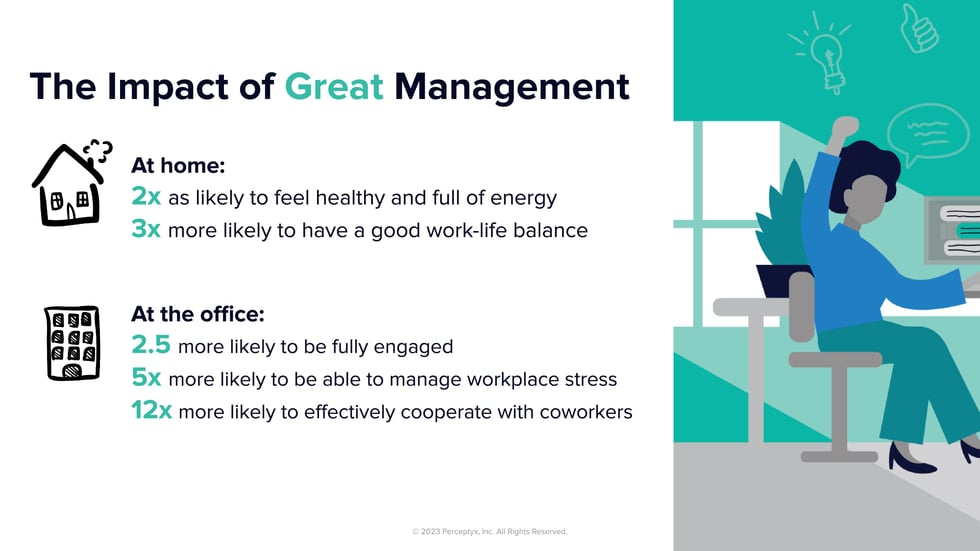
The strain of working for a poor manager spills into life outside the office. Employees with their worst boss are more than twice as likely to experience:
-
Difficulty enjoying personal activities
-
Tension that leads to poor behavior with family and friends
-
Negative coping behaviors such as substance use
-
Sleep disruptions caused by work-related stress (reported at more than three times the rate of employees with great managers)
With these outcomes on the line, organizations that prioritize the development of effective managers see gains in both employee experience and financial results. Purposeful training and intentional growth plans turn capable individual contributors into confident leaders. By investing in manager development, companies build a positive culture, raise productivity, and retain top talent while warding off burnout.
Frequently Asked Questions
How does a great manager boost employee engagement?
Great managers are the single most powerful driver of employee engagement. Employees who describe their supervisor as the "best boss ever" are 2.5x more likely to be fully engaged compared to those working under their worst boss. This engagement translates into tangible workplace behaviors: these employees consistently exert discretionary effort beyond their job descriptions, actively advocate for the organization's brand both internally and externally, and demonstrate strong intent to remain with the company long-term.
The foundation of this engagement lies in three core elements that great managers provide: genuine support for professional growth, authentic care for employee well-being, and the establishment of trust through consistent, transparent communication. When managers deliver on these fundamentals, they create an environment where employees feel valued, heard, and motivated to contribute their best work. This manager-employee relationship becomes a multiplier effect — engaged employees inspire their peers, strengthen team cohesion, and elevate overall organizational performance in ways that directly impact the bottom line.
How do effective managers improve business results?
Effective managers drive measurable business outcomes by removing organizational friction and fostering seamless collaboration across teams. The data reveals a striking contrast: 80% of employees working under their best boss report favorable cooperation with other departments, compared to just 25% of those under poor managers—a difference that directly affects project velocity, innovation, and customer outcomes. Great managers excel at placing people in roles that align with their natural strengths, which reduces workplace friction and accelerates productivity. Beyond day-to-day operations, these managers create strategic alignment throughout their teams. Employees with the best managers are 5.3x more likely to connect with the organization's future vision, ensuring that daily work ladders up to broader company objectives. They're also 2.7xmore likely to feel supported in their skill and career development, which builds internal talent pipelines and reduces costly external hiring. Perhaps most significantly, employees with great managers are 5.7x more likely to feel a genuine sense of belonging in the organization — a critical factor in retention. When you combine reduced turnover costs, increased productivity from properly aligned talent, enhanced cross-functional collaboration, and a workforce that understands and works toward shared goals, the cumulative business impact becomes substantial and sustainable.
How does good management support employee health and well-being?
The relationship between management quality and employee well-being extends far beyond the workplace, affecting every aspect of an employee's life. Teams led by supportive managers are five times more likely to believe their organization genuinely prioritizes their health and well-being. These employees consistently report manageable stress levels, reasonable workloads, and better work-life balance—regardless of the actual number of hours worked. The perception of support matters as much as the reality, and great managers create both. The contrast becomes even more pronounced when examining the negative outcomes associated with poor management.
Employees working under their worst boss are more than twice as likely to experience difficulty enjoying personal activities outside of work, face tension that leads to poor behavior with family and friends, and engage in negative coping behaviors such as substance use. Most alarmingly, these employees report sleep disruptions caused by work-related stress at more than three times the rate of those with great managers. This sleep deficit alone creates a cascade of health problems that affect cognitive function, emotional regulation, and long-term physical health. When managers prioritize employee well-being through reasonable expectations, open communication about workload, and genuine concern for work-life integration, they create a virtuous cycle: healthier employees perform better, experience less burnout, take fewer sick days, and sustain higher productivity over time. Organizations that invest in developing managers who understand this connection see returns in both employee experience metrics and financial performance.
What is a 30-60-90 plan, and why should new managers use one?
A 30-60-90 plan is a structured onboarding framework that sets clear, progressive goals for a manager's first three months in a new role, dramatically increasing the likelihood of early success and long-term effectiveness. The plan divides the critical first quarter into three distinct phases, each with specific objectives and measurable outcomes. During the first 30 days, the focus is on learning — new managers invest time in understanding team dynamics, individual employee strengths and development areas, existing processes and workflows, key stakeholders across the organization, and the cultural norms that shape how work gets done. This learning phase prevents the common mistake of implementing changes before fully understanding the current state.
By day 60, managers shift into improvement mode, using insights from the first month to identify and address workflow inefficiencies, strengthen communication channels, build trust through consistent one-on-one meetings, and begin implementing small, visible improvements that demonstrate their value. The final 30 days focus on delivering measurable wins — tangible results that prove the manager's positive impact on team performance, employee engagement, or business outcomes. This might include improved team metrics, successful project completions, enhanced cross-functional collaboration, or documented increases in employee satisfaction scores.
The structured nature of a 30-60-90 plan offers multiple benefits: it focuses managerial effort on the highest-impact activities during a vulnerable transition period, builds credibility and trust with team members who see their new leader taking a thoughtful, systematic approach, accelerates the manager's ability to positively influence engagement and performance, and provides clear benchmarks for self-assessment and feedback from leadership. Organizations that require 30-60-90 plans for new managers—whether they're first-time leaders or experienced managers joining from other companies—see faster ramp-up times, fewer early missteps, and stronger long-term manager effectiveness.
Our full report, The Management Behaviors That Make (or Break) a Great Employee Experience, analyzes the state of management in 2023 and offers practical strategies to promote positive leader behaviors, enhance employee engagement, and maintain a healthy, productive workplace. Watch our on-demand webinar for detailed analysis and implementation strategies. Click here to download the report.