
Employee Experience: Strategy, Surveys, and Always-on Listening

When Perceptyx compared highly engaged employees to their disengaged peers across more than 20 million survey responses, the engaged group was 84% less likely to be actively job-seeking, 3x more likely to report year-over-year productivity gains, and 9x more likely to express overall company satisfaction. These advantages begin with engagement but are sustained by a broader ecosystem of employee experience factors: growth, collaboration, well-being, and more.
When Perceptyx compared highly engaged employees to their disengaged peers across more than 20 million survey responses, the engaged group was 84% less likely to be actively job-seeking, 3x more likely to report year-over-year productivity gains, and 9x more likely to express overall company satisfaction. These advantages begin with engagement but are sustained by a broader ecosystem of employee experience factors: growth, collaboration, well-being, and more.
For decades, organizations measured employee engagement to understand how people felt about their jobs and employers. Engagement remains an important outcome. But organizations that stop there risk creating an employee experience that is 30 years out of date. During the past five years alone, we have weathered a global pandemic, unprecedented business consolidation, the hybrid-work revolution, and the dawn of generative AI. Each disruption has stretched the definition of work and revealed blind spots that a narrow focus on engagement simply cannot illuminate.
What Is Employee Experience?
Employee experience (EX) is the complete set of perceptions, interactions, systems, and emotions that shape an employee's life at work, from their first day on the job to their last. Organizations benefit from measuring the experiences of candidates and alumni as well. Engagement sits inside that larger frame, alongside many other factors that together explain why people stay, leave, thrive, or struggle.
In the HR context, employee experience covers everything across the employee lifecycle from recruitment through exit. HR professionals approach EX by considering the entire employee journey, including the moments that matter at each stage.
Understanding and predicting employee behavior sits at the core of any organization's listening strategy. Whatever high-level business or talent priority your organization pursues (change management, retention, DEIB), many aspects of work and the employee experience can inform your listening events.
How Does Employee Experience Differ From Employee Engagement?
While employee engagement and employee experience are closely related concepts, they are distinct and serve different purposes. Employee engagement is one important outcome of a great employee experience. It focuses on the emotional and psychological connection employees have with their work and organization. Employee experience encompasses a broader perspective of an employee's journey within the company, including measures that influence engagement (such as growth and development opportunities) and additional outcomes distinct from engagement (such as health and well-being).
At Perceptyx, we define employee engagement as the combination of four themes:
- Motivation: The extent to which doing work at the organization gives employees a sense of personal accomplishment and fulfillment
- Pride: The extent to which employees feel proud to work at their organization
- Advocacy: The desire for employees to recommend their workplace to those close to them
- Retention: The intent of employees to remain at the organization for the foreseeable future
Engagement measures tell us the what but not the why. Elements of the employee experience provide the why of whether or not employees are engaged. To find those specific elements, organizations must ask employees to share their perceptions about the entire range of their experiences to determine what works and where there may be barriers to engagement.
|
Dimension |
Employee Engagement |
Employee Experience |
|
Definition |
An outcome: commitment, enthusiasm, willingness to advocate and stay |
The totality of perceptions and interactions that shape life at work |
|
Core Question |
"How invested are you in your work and employer?" |
"What is it like to work here, and how does that affect what you do?" |
|
Scope |
Four themes (Motivation, Pride, Advocacy, Retention) |
Ten factors, forty themes including engagement plus growth, well-being, inclusion, collaboration |
|
Measurement Cadence |
Often an annual, single survey |
Continuous: census + pulse + lifecycle + behavioral signals |
|
Primary Use |
Gauge morale; track high-level health |
Diagnose root causes; design targeted interventions; predict performance |
Engagement remains a vital sign, but treating it in isolation is like treating a fever without asking what caused it. By mapping the entire landscape of employee experience, organizations can see both the symptom and the source.
Why Should Leaders Prioritize Employee Experience?
Research has clearly linked high engagement scores to higher productivity, lower turnover, stronger customer loyalty, and safer workplaces. Yet organizations that still rely on a single annual engagement survey are making decisions with an instrument built for another era.
Today's workplace is an ever-expanding multiverse of locations, schedules, and technologies. Employees want flexibility, inclusion, and meaningful growth. They care about well-being, manager trust, fair recognition, and the ethics of the products they help create. They want a positive experience, and they are quick to leave employers who fail to provide it.
Perceptyx research found that employees who are considered highly engaged at work score 27% higher on feeling valued as an employee compared to disengaged employees. This suggests that engagement can be a reciprocal relationship: when employees engage with their work and the organization, they reap rewards in the form of feeling valued. The findings about feeling valued and job-seeking behavior are connected: employees who are highly engaged are 84% less likely to be engaging in job-seeking behavior than those who are disengaged, even after controlling for industry, organizational tenure, and income.
Given the direct and indirect costs of high employee turnover, creating and maintaining a positive employee experience represents a tool for stopping employee turnover before it starts. Perceptyx research found that highly engaged employees were over 9x more likely to report being satisfied with the company they work for, which itself is a key driver of job-seeking behavior.
Beyond retention, employees also report being more productive when engaged. When asked whether they were more productive now than at the same time last year, fully engaged employees were 3x more likely to report they were more productive now compared with their disengaged counterparts.
What Components Make Up the Employee Experience?
Perceptyx distilled two decades of behavioral science, 20 million survey responses, and hundreds of listening events into the People Insights Model, which essentially serves as a common language for the employee experience. The PIM identifies 10 core factors and 40 underlying themes that predict critical outcomes such as retention, discretionary effort, inclusion, customer satisfaction, and safety.
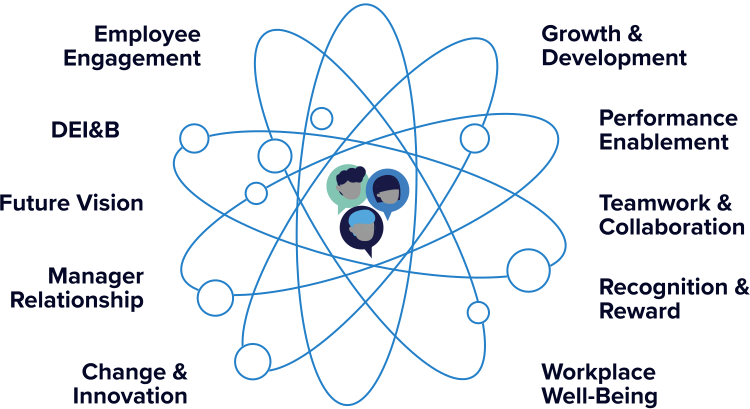 Each factor captures a critical slice of the work experience; the themes supply the detail managers need to act. For instance, learning that Growth & Development is weak can point leaders in the right direction; learning that feedback quality is the precise pain point tells them exactly where to start.
In predictive validation studies, Perceptyx tested the PIM against outcomes leaders care about most: job-seeking behavior, company satisfaction, management effectiveness, and more. The data showed that no single factor dominated every outcome, and each factor uniquely predicted at least one outcome. This finding has been replicated across dozens of customer studies, demonstrating the importance of measuring all ten factors to develop effective listening and action strategies tailored to your organization's specific challenges.
This variability highlights two points. First, the employee experience is a multidimensional system where different factors influence different outcomes. Second, you must measure all 10 factors to know where to act for any given challenge. The People Insights Model encompasses three interconnected environments that shape daily work life.
Cultural Environment
Organizational culture includes shared values, beliefs, leadership style, and interpersonal dynamics. This is the "feel" of the workplace: how employees experience their relationships and sense of belonging.
Psychological Safety and Belonging
Psychological safety has become central to the DEIB conversation. Employees must believe they can speak up without fear of consequences. Perceptyx research shows that physical safety and psychological safety are inseparable: when employees fear blame, criticism, or career damage for speaking up about concerns, hazards multiply in silence. Managers who understand that creating psychological safety requires setting aside time in team meetings to emphasize that people should be free to speak their minds without fear of judgment or consequence see measurable improvements in both incident reduction and employee engagement.
IPG Mediabrands found that the "outsized impact that executive leadership perception had on belonging" was their most surprising discovery. After doubling down on executive leadership commitment to creating an inclusive environment, they experienced significant score jumps on key belonging questions. The lesson: culture change starts at the top but must be modeled throughout leadership to achieve employee buy-in.
People-First Culture
People-first cultures actively create desirable work environments that consider and fulfill employee needs. To remain competitive, organizations must make genuine connections with employees, providing purpose, belonging, well-being, safety, and a sense of being valued. Perceptyx research found that 50% of employees whose organizations do not meet their top 5 employee value proposition attributes intend to leave within the year, while less than 5% of those whose organizations do meet their needs said the same.
The Teamwork & Collaboration factor in the People Insights Model consists of four themes that reveal what affects employees' cultural experience:
- Co-worker Relationships: Do employees feel positively about their relationships with colleagues?
- Collaboration: Are employees satisfied with opportunities to collaborate?
- Psychological Safety: Do employees feel safe speaking up without fear of judgment?
- Ethics & Integrity: Do employees trust the company's ethical standards?
If employees score well on relationships and collaboration but struggle with psychological safety and question the company's ethics, organizations can begin to understand what might be driving lower engagement or higher safety incidents.
Physical Workspace
The physical workspace is the tangible work environment, including office design, remote work setup, amenities, and safety. Hybrid and remote work have fundamentally expanded the definition of the physical workspace.
The Hybrid Work Advantage
A 2022 Perceptyx study found that hybrid workers report the greatest improvements in productivity, work-life balance, and mental health compared to fully remote or fully in-office peers — and research from 2025 showed that they have the greatest understanding of organizational mission and goals. The data challenges traditional "officism" bias, the preconceived notion that on-site employees are inherently better workers.
Key findings from Perceptyx research on hybrid work:
- Hybrid employees are 50% more likely to look forward to starting their workdays and feel they make meaningful contributions
- More than half of hybrid workers (53%) report stronger relationships with coworkers and managers than last year, compared to only 34% of fully remote workers and 38% of in-office workers
- Hybrid employees are nearly twice as likely to feel energized by their work than either fully remote or fully in-person counterparts
- Hybrid workers were most likely to say their own productivity is up, while in-person workers were most likely to say productivity is lower
The data indicates that it's not how much time employees spend in the office that improves relationships, but how purposeful those in-office interactions are. About a third of employees feel disconnected from their coworkers, and that number is quite similar regardless of the amount of time spent in the office.
Managing the Hybrid Workforce
Organizations need to be deliberate about how they address factors impacting remote and hybrid workers. A clear bias has emerged: employees who are on-site 4-5 days per week are more likely to receive higher performance ratings compared to peers who spend less time in a physical work location. This perpetuates the assumption that those who are physically present are better performers, regardless of actual output.
The return-to-office debate continues, with our latest research finding that 61% of employees saying their organization has made remote/hybrid work rules more restrictive. Nearly 60% of executives and VPs believe in-person collaboration is more effective, compared to only 45% of individual contributors. This disconnect between leadership and employees may be influencing stricter RTO policies even as employee sentiment remains divided.
To create equitable employee experiences for all workers, organizations must:
- Systematically audit promotion and development data across work arrangements
- Establish clear visibility protocols that create structured opportunities for all employees to demonstrate contributions regardless of location
- Invest in manager training for distributed leadership
- Develop team collaboration techniques that work across locations
C.H. Robinson partnered with Perceptyx to develop pulse surveys segmented by three distinct employee personas: in-office (80-100% on-site), hybrid (60-80% on-site), and remote (0-10% on-site). They focused on culture, technology, and space as core components of the employee experience, learning how different employees felt about returning to the office and taking targeted action in response.
Safety Culture in Physical Workplaces
For organizations where employees work in physical locations (manufacturing, healthcare, retail), measuring safety culture has life-and-death consequences as well as implications for retention and customer satisfaction. BJC Healthcare partnered with Perceptyx to develop a 13-question safety culture survey focusing on psychological safety, teamwork, continuous improvement, and overall safe care. They beat their participation goal by 6%, with more than 10,000 employees completing the survey in two weeks.
Common barriers to safety culture include lack of leadership commitment, punitive reporting environments, distractions in busy workplaces, and inadequate staffing. Organizations can overcome these by instituting anonymous reporting mechanisms, using mistakes as learning opportunities rather than punishment, and creating "no-interruption zones" around dangerous tasks.
Digital and Technological Experience
The digital and technological experience includes the tools, platforms, and systems employees use daily. Technology friction or enablement directly impacts daily work satisfaction.
The "Always-On" Challenge
According to our research, today’s increasingly digital-first workplaces have profound implications for employee well-being. The percentage of time that office-based employees spend at their desks has skyrocketed to approximately 90% (compared to about 30% in the pre-digital era), fostering an environment where constant availability has become the norm.
This shift toward constant connectivity has introduced challenges in attention management and executive function. The barrage of digital notifications, expectations of immediate responses, and a culture of multitasking have led to diminished work quality, burnout, and declining mental health. Perceptyx benchmark data shows:
- Pride in Organization: A significant drop of -2.8 points indicates growing disconnection between employees and their organizations
- Intent to Stay: A decrease of -1.7 points signals risk of increased turnover
- Likelihood to Recommend: A -1.3 point drop could impact talent acquisition and retention
- Well-being levels still have not matched pre-pandemic levels despite some rebound
Technology as Experience Enabler
When employees have the technology and resources they need, their experience improves dramatically. Our Activate AI agent provides valuable feedback to managers about the positivity, negativity, and regularity of their email and chat communications with employees. This AI-powered solution helps managers identify unconscious behaviors that might be unfair to certain team members.
Organizations should ask employees directly about their technology experience:
- Do employees have the technology and resources needed to work effectively from any location?
- Do on-site employees feel safe at their physical workplace?
- What caregiving or personal responsibilities are employees juggling alongside work?
- Is technology creating friction or enabling productivity?
Crowdsourcing enables employees to co-create solutions and vote on their peers' suggestions, creating a sense of ownership and shared responsibility for organizational improvements. This method has shown measurable results in enhancing organizational culture, demonstrating its effectiveness in engaging the workforce in meaningful dialogue about what's working and what needs to change.
Integration Across Environments
The three environments interact continuously. Perceptyx's 2025 EX IMPACT Award winners demonstrate how organizations successfully integrate across all three:
- Advocate Health consolidated 250 survey questions covering Culture of Safety to DEI into a unified 49-question "Culture of Safety and Work Environment Survey," attracting participation from 86,000 teammates
- Emerson Electric created a comprehensive enterprise well-being strategy based on four pillars: physical, mental, financial, and social support
- Perficient increased ERG participation from 20% to 35% in three years, with 93% of colleagues indicating they work well across global teams (32 points above Perceptyx benchmark)
- Coca-Cola Southwest Beverages introduced AI-assisted intelligent nudges through Activate, targeted engagement action plans, and continuous listening and learning programs
The organizations that thrive are those that recognize culture, physical workspace, and technology as an interconnected system rather than isolated elements. The People Insights Model provides the framework for measuring all three environments and connecting insights to targeted actions that improve the complete employee experience.
How Should Organizations Build an Employee Experience Strategy?
A framework is only useful if it leads to change. The PIM links every theme to specific, research-backed behaviors and concrete actions: nudges, manager toolkits, discussion guides, and AI-powered action plans. The model supports an integrated listening strategy that combines:
- Census surveys for a broad view of all 10 factors
- Pulse surveys to monitor priority themes or cohorts
- Lifecycle surveys (onboarding, exit, promotion) to pinpoint moments that matter
- Crowdsourcing and open-text analytics to surface ideas and stories in employees' own words
- Start with the business question. What keeps leaders awake at night: customer churn, innovation speed, safety, labor cost? Prioritize the employee experience factors most likely to influence that outcome.
- Map the listening architecture. Combine a broad census with targeted pulses and lifecycle checkpoints. Layer in passive data where ethical and practical.
- Use the People Insights Model to guide analysis. Identify the themes with the strongest statistical link to the outcome. Segment by role, tenure, location, or demographic group to uncover pockets of strength and risk.
- Translate insights into behaviors. For each priority theme, surface the 2-3 behaviors that have the highest payoff. Example: under Growth & Development → Feedback, focus on "frequent, coaching-style conversations."
- Deliver personalized actions. Equip managers with bite-sized nudges and AI-powered resources in the flow of work. Provide leaders with dashboards and playbooks. Empower employees to own their own experiences.
- Close the loop and tell the story. Share what you heard, what you're doing, and where you need help. Transparency drives trust, and trust fuels participation in the next listening cycle.
- Measure, adjust, and repeat. Track progress quarterly. Celebrate quick wins, learn from missteps, and iterate. Continuous listening paired with continuous action is the engine of experience transformation.
What Role Do Managers Play in Employee Experience?
Managers are the essential interface between strategy and reality. They influence nearly every PIM factor: engagement, collaboration, well-being, growth, and inclusion. Organizations must therefore invest in manager capability through:
- Data literacy to interpret team-level insights
- Coaching skills to create psychological safety and growth
- Change management to navigate constant disruption
- Well-being advocacy to balance performance and sustainability
When managers act on accurate, timely EX data, they become catalysts for culture rather than mere conduits for corporate policy. According to Perceptyx benchmark data, the top global themes driving engagement are Change Management, Confidence in Senior Management, Career Opportunities, and Belonging.
How Can Organizations Implement Continuous Listening?
The rise of remote and hybrid work arrangements has added complexity to managing employee experiences. With less direct oversight, organizations face new challenges in maintaining consistent experiences across different work setups. For employees working remotely, either full or part-time, the boundaries between work and personal life often blur, requiring managers to develop new skills to effectively supervise and support their teams.
Equity in diverse work arrangements has also become an important consideration. Organizations must ensure that all employees, regardless of their work location or arrangement, have equal opportunities for development, advancement, and engagement. This includes addressing potential disparities in access to resources, visibility within the organization, and participation in company culture.
More than two decades of experience as a listening provider has made one thing clear: the best way to engage employees is by valuing their voices and acting on their feedback. Original Perceptyx research and our direct work with customers tells us that going directly to the front lines to understand the barriers to employees' success is the most effective way to show an organization cares about their feedback.
The key to removing barriers to engagement and improving the experience is an ongoing dialogue between the organization and employees. A listening program tailored to the unique needs of the organization, with surveys and other listening events designed to elicit employee feedback on the experience and issues of strategic importance, is one of the best ways of uncovering the insights needed to improve the experience. But surveys alone are not enough. Crowdsourcing, company message boards, team conversations, or even one-on-one conversations between managers and employees are other ways to keep the dialogue going.
Most important is following through with action. Even if you've gone to the trouble to measure engagement and listened to find out where there is dissatisfaction with the experience, nothing will change without action. Asking without acting can actually drive engagement lower.
How Should Organizations Measure Employee Experience?
The employee experience cannot be measured by a one-dimensional survey score. Measuring employee experience goes deeper than a rote checklist of questions. The questions you ask should encompass all aspects of the work experience and be customized to your organization's culture and values as well as job role and work location. Because the worker experience is incredibly complex, organizations must use their valuable survey real estate meaningfully, combining comprehensive listening events with targeted deep-dives on critical aspects.
Engagement Surveys (Census Surveys)
More than 85% of enterprise organizations include annual census surveys in their listening strategies. Census surveys collect employee perceptions about a comprehensive range of themes and should be tailored to measure what matters most. The Perceptyx four-item engagement index measures pride, advocacy, motivation, and retention. Research shows that employees who evaluate their manager as ineffective are more than 6x as likely to report they will leave within a year compared to those who evaluate their managers as effective.
Pulse Surveys
Pulse surveys can be much more targeted than census surveys, focusing on measuring the moments that matter. Perceptyx research shows that 75% of organizations now listen to employees at least quarterly, compared to just 18% surveying more than once per year a decade ago. Pulse cadence should match organizational capacity for action.
Employee Net Promoter Score (eNPS)
The Employee Net Promoter Score measures responses on an 11-point scale, sorting individuals into Promoters (9-10), Passives (7-8), and Detractors (0-6). An eNPS from 10 to 30 is generally considered good; above 50 is excellent. eNPS scores vary widely across industries: for example, manufacturing saw eNPS increase from 21 in 2022 to 32 in 2023, while Information dropped from 46 to 23 in the same period. While eNPS can function as a quick measure of engagement, a more comprehensive index provides deeper insight.
Lifecycle Surveys
Lifecycle surveys are triggered by specific events in the employee journey. Perceptyx recommends three surveys at critical onboarding touchpoints: at 2-4 weeks (to assess welcome and resources), within 3 months (to measure belonging and fit), and within 6-12 months (to gauge alignment between expectations and reality). Exit surveys reveal how experiences differed for those who left versus those who stayed, providing the key to lowering attrition.
Quantitative and Qualitative Analysis
Quantitative data tells us WHAT employees are experiencing. Qualitative data gets us to the WHY behind the experience. When comparing responses of unengaged versus engaged employees, qualitative analysis reveals what is different in their experiences and suggests interventions for improvement.
Key Performance Metrics
Organizations should track operational metrics indicating experience quality: retention rates, time-to-productivity, internal mobility, and absenteeism. A major restaurant chain discovered that for every point increase in employee engagement scores, there was a corresponding improvement in call resolution and customer satisfaction. This integration of employee experience data with business metrics demonstrates clear ROI for EX investments.
Organizations cannot simply tell employees to be more engaged. Instead, they must first determine what drives engagement and then target those predictors. For example, if a driver is a lack of opportunities for career progression (part of the Growth & Development factor), improving development programs or upskilling managers for more effective performance conversations leads to improved engagement over time. Whether through coaching, AI-powered action planning, or Intelligent Nudges, companies can take data-driven actions to enhance employee experience.
What Challenges Do Organizations Face With Employee Experience?
Perceptyx research has identified the most significant barriers preventing organizations from seeing maximum impact from their listening strategies.
Action Planning and Follow-Up
Taking action is the biggest barrier to a successful listening program. If your organization shifts to more frequent listening without appropriate follow-up actions, employees may experience inaction fatigue. Asking without acting can actually drive engagement lower. Perceptyx recommends the 1-2-3 model: choose one problem, identify two actions, and communicate about actions at least three times.
Lack of Executive Support
Without executive commitment, EX initiatives stall or become isolated HR projects. Describing the explicit connection between listening data and business priorities executives care about is critical to maturing a listening strategy. Only 25% of organizations report having a clear set of outcomes they are trying to achieve with their listening strategy.
Lack of Alignment to Business Outcomes
Organizations struggle to connect EX initiatives to measurable business outcomes. Leading organizations connect listening strategies directly to key business outcomes like retention, customer focus, or enterprise transformation. When employees and leaders see how feedback supports broader business objectives, they are more likely to engage and champion resulting efforts.
Cultural Resistance to Change
Organizational inertia and the "we've always done it this way" mindset must be overcome. Crowdsourcing can amplify employee voices and allow them to see feedback incorporated into future strategy — something that MetroHealth cited as one of the main success factors for the improvement of their safety culture following the implementation of their listening platform.
Resource Constraints and Sustaining Momentum
Competing priorities require a strong business case for EX investment. More than 4 in 10 HR leaders say their jobs have become more stressful. Mature organizations embed listening throughout the employee lifecycle, from candidate experience through exit and beyond, ensuring they capture feedback at moments that matter and maintain continuous dialogue rather than episodic check-ins.
The literature on EX impact on performance, retention, and organizational outcomes is clear: A poor experience drives regrettable turnover, and improving it prevents top performers from leaving. The importance of employee health and well-being has emerged as a top business and talent priority.
How Can Technology Enhance Employee Experience Programs?
Employee listening platforms enable organizations to gather continuous feedback across multiple channels, analyze sentiment patterns, and identify specific actions that will have the greatest impact on experience and business outcomes.
For example, with Perceptyx’s platform, managers can get concrete, specific recommendations rather than vague suggestions for improvement. The scalable impact of behavioral nudges, delivered via Teams, Slack, mobile, or email, shows up in the data: Employees receiving nudges are 32% less likely to leave, manager performance ratings improve by 40%, and 96% of recipients report noticeable positive changes in their workplace experience.
Continuous listening enables organizations to identify issues early, understand employee sentiment in real-time, and take timely action. This approach replaces outdated annual survey models with dynamic, responsive feedback systems that deliver real-time insights, trend detection, and action enablement.
Employee experience is a strategic driver of organizational success rather than just an HR initiative. The connection between how employees feel and how the business performs is clear. Organizations that invest in comprehensive employee listening and action programs see measurable results: higher retention, stronger productivity, and improved business outcomes.
Improving the employee experience by continuously asking for and acting on employee feedback is how organizations achieve high engagement and reap its rewards. The work is long, incremental, and continual, but improvements along the way benefit everyone: organizations get the benefits of an engaged workforce, and workers spend their workdays with a good manager, a chance to learn and grow, and a sense of belonging.
Ready to transform your employee experience? Talk to our experts to explore how Perceptyx can help transform employee feedback into measurable business impact.