
What Happens When Managers Act on the Wrong Employee Survey Items?
Key Takeaways: A leading industrial technology organization asked managers to build action plans after its census survey. The top five questions most frequently submitted for action plans improved year over year, with gains ranging from 3.4 to 13.4 points. However, engagement rose only in the cohorts where the action item was a top driver: communicating a clear vision for the future and the ability to achieve career goals. Teams that acted on cross-department collaboration, pay satisfaction, or benefits improved those scores but saw engagement dip a point or hold flat. The pattern appeared only when engagement trends were matched to the specific item each manager submitted an action plan for.

Managers at a leading industrial technology organization — one of the customers I support — submitted action plans after the 2025 census. Following their 2026 annual survey, Perceptyx identified the five most frequently-chosen action items from 2025 in order to see whether action plan submission led to improvements in those areas. Every one of those items had improved, but more importantly, engagement had risen only in the cohorts where the actioned item was an engagement driver. That split answers a question many action-planning programs never test: whether improving an item score improves the outcome the organization selected the item to serve.
What Did the Data Show When Managers Acted on Their Survey Results?
After its 2025 survey, the organization identified five top action-planning items, and managers submitted action plans against them. A year later, all five items had improved:
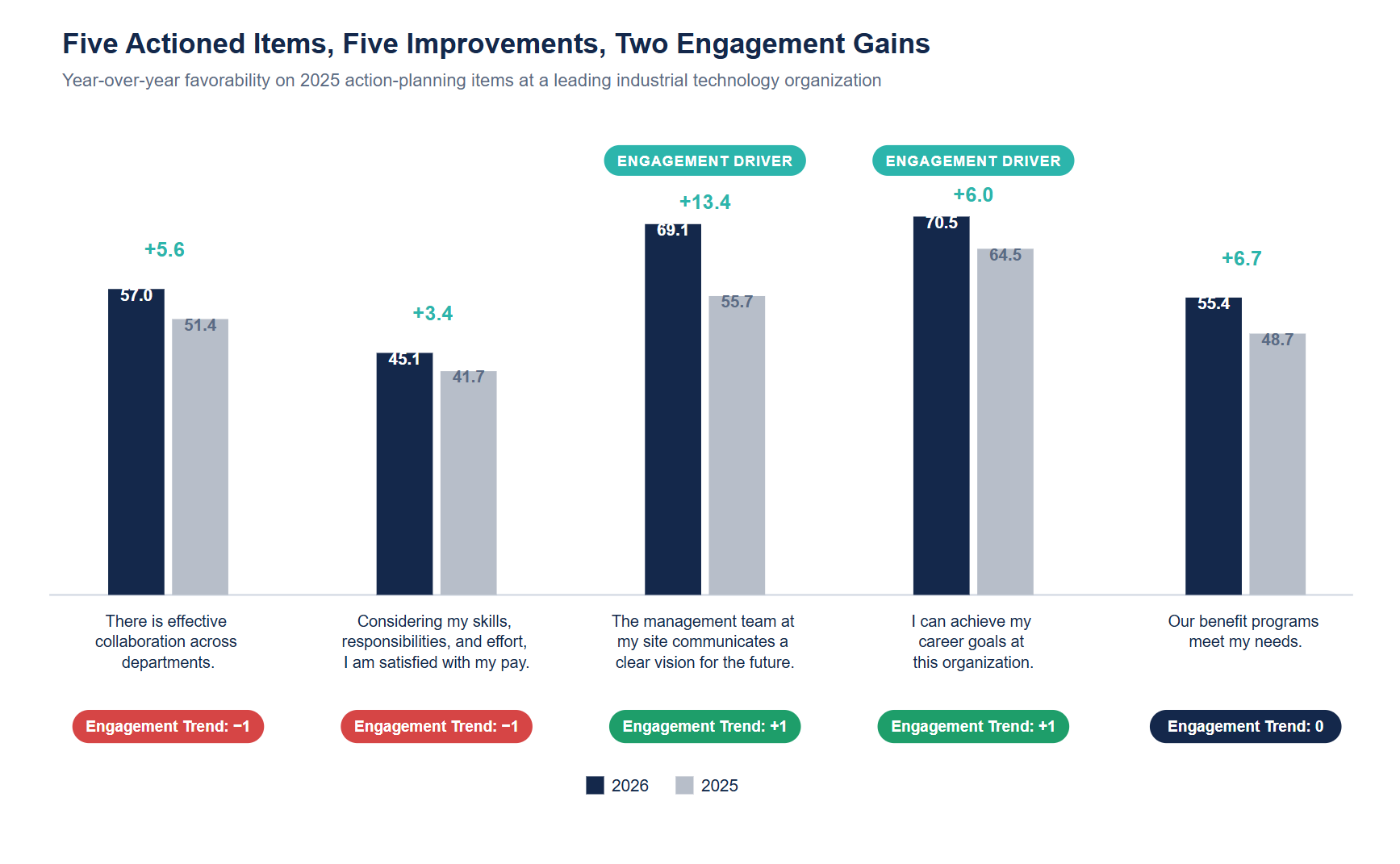
- The management team at my site communicates a clear vision for the future: 55.7 to 69.1, a 13.4-point gain
- Our benefit programs meet my needs: 48.7 to 55.4, a 6.7-point gain
- I can achieve my career goals at this organization: 64.5 to 70.5, a 6.0-point gain
- There is effective collaboration across departments: 51.4 to 57.0, a 5.6-point gain
- Considering my skills, responsibilities, and effort, I am satisfied with my pay: 41.7 to 45.1, a 3.4-point gain
Why Did Engagement Rise for Some Teams and Not Others?
When analyzing the most frequently-chosen action items, only two were engagement drivers for this organization: clear vision for the future and career goal achievement. In the cohorts that acted on those two items, engagement rose one point. In the cohorts that acted on collaboration or pay, engagement fell one point despite the item gains. In the benefits cohort, engagement held flat.
Looking at overall engagement trends for all managers who submitted action plans showed no relationship. In fact, engagement was lower for teams where managers did versus did not take action (79.5 vs. 82.2). The linkage appeared only when each cohort's engagement trend was matched to the specific item its manager submitted an action plan on. Managers improved what they focused on, and engagement followed only where the focus landed on a driver.
Why Didn't Better Pay and Benefits Scores Lift Engagement?
The organization took action in the area of Total Rewards and saw scores slightly improve across the board (though they were extremely low to begin with). And, within the cohorts where managers submitted plans on these topics, pay satisfaction rose 3.4 points and benefits rose 6.7 points in their cohorts, yet engagement in those cohorts declined or held flat. Why? These items do not drive engagement.
At the local levels, Perceptyx best practices recommend aligning and co-creating action items and plans that are both 1) within a manager’s control and 2) likely to improve engagement. Pay and benefits are typically the lowest-scoring questions in a survey, but Perceptyx panel research shows a weak link between compensation and engagement: in a study of more than 3,000 workers, employees who received a raise in the preceding three months were only 30% more likely to be engaged than those who did not, while well-recognized employees were seven times more likely to be fully engaged. While compensation is typically not 100% within a manager’s control, recognition and appreciation certainly are.
Compensation and benefits scores are worth improving on their own terms, because they affect fairness perceptions and set a retention floor. This is why it’s helpful to communicate results and take action at the organizational level, but in benchmark data, these topics rarely predict who becomes engaged.
In the 2026 Perceptyx Benchmark Database of more than 23 million responses, four of the five top engagement drivers describe how the organization handles change and what future it offers: effective change management, confidence in senior leadership, leaders leading change well, and access to career opportunities. A site management team communicating a clear vision and employees believing their career goals are achievable are local expressions of those drivers.
How Do You Know Which Items Drive Engagement at Your Organization?
Perceptyx identifies drivers by comparing favorability between highly engaged employees and the rest of the population. The larger the gap on an item, the more closely that item is associated with engagement, and the more leverage a manager gets from acting on it. Drivers vary by organization, industry, and year: career growth and recognition topped the list before the pandemic, while change management effectiveness and confidence in senior leadership claimed the top positions by 2025. Of course, it bears noting that an item that drives engagement at one organization can be background noise at another, so the driver analysis needs to be run on your own data.
Low-scoring items pull attention in action planning because they look like the biggest problems. This organization's data shows the cost of that instinct: pay satisfaction was the lowest-scoring item of the five, managers improved it, and engagement in those cohorts still fell. A driver analysis reorders the priority list by expected return rather than by an abstract score.
What Should Next Year's Action Plan Look Like?
After the 2026 survey, the organization communicated the importance of focusing first on drivers within a manager’s control, instead of jumping to the lowest-scoring questions. They expect to see more managers focusing on the right things as they gear up for 2026 action planning.
How do you do this? First, run the driver analysis before selecting action items, so the shortlist starts with the items statistically tied to the outcome the organization wants to move. Then measure both the item and the outcome by cohort, matching engagement trends to the item each manager acted on, because that analysis reveals whether the effort is paying off.
The 2026 Perceptyx Benchmark Report details the current top engagement drivers across 23 million responses and 20 industries, including the change-management and career-growth items that moved engagement in this case. To see how Perceptyx can help identify the drivers specific to your workforce and how its People Activation System turns them into targeted manager action, schedule a demo with our team.