
Employee Listening: What Changed and What Drives It

Employee listening has become a core business function, moving well beyond annual engagement surveys to continuous, multi-channel programs that connect employee feedback to measurable outcomes. Organizations that listen effectively can identify critical needs faster, act on insights in real time, and strengthen their ability to attract and retain talent.
The same principles that drive customer loyalty apply to your workforce. Engaged, productive employees deliver lifetime value to your organization throughout their tenure, then act as brand ambassadors after they leave. When organizations provide employees with the same quality of experience they deliver to customers, they see gains in loyalty, productivity, and retention across the employee lifecycle.
Several forces have reshaped how organizations listen to their people. The shift to hybrid and remote work accelerated expectations for real-time feedback. Employee expectations continue to evolve, with workers seeking more flexibility, connectivity, and purposeful work alongside traditional compensation and benefits. And technology has fundamentally changed how organizations communicate, gather feedback, and act on what they hear. Below, we explore the key factors that have transformed employee listening into a strategic business function.
Why has employee well-being become a strategic priority?
Most organizations now recognize that understanding employee thoughts, beliefs, attitudes, and ideas requires more than a single annual check-in. For years, many organizations focused on monitoring engagement levels once a year, identifying the strongest drivers of engagement and the constraints across the employee experience. This was particularly important for improving employee retention in tight labor markets. But as business conditions became more volatile, a fundamental limitation emerged: annual surveys could not keep pace with the speed ofchange. The traditional approach was no longer sufficient on its own. It needed to be supplemented by a continuous listening strategy for capturing employee sentiment in both the short and long term.
Understanding employee sentiment remains a priority, but the scope of listening has expanded well beyond engagement. Employee well-being has become a central focus, and organizations that measure it effectively can connect wellness outcomes to retention, productivity, and overall business performance.
The rapid transitions of recent years revealed that employee surveys are more than annual engagement check-ins. Employee listening programs backed by well-designed wellness surveys serve as a means to communicate care, respond to concerns, prioritize investments, and take action in realtime.
Organizations have responded by increasing the frequency and variety of their listening efforts. Weekly pulse surveys with just two or three targeted questions have become common, allowing leaders to capture sentiment quickly without overburdening employees. Lifecycle check-ins at key moments, such as onboarding, role transitions, and exits, add depth to the picture.
These approaches build organizational competency around data-driven methods for studying people, processes, and systems, helping to elevate the employee experience and drive sustainable business growth.
How does the feedback economy shape employee expectations?
Digital channels have given customers direct, public access to businesses—through social media, review sites, and community forums—and employees now expect the same feedback tools in the workplace. Anyone can interact with a business through a simple tweet. Customers may also want to instantaneously express feelings about their experiences with a product or service (particularly if those experiences are either poor or spectacular) by posting feedback on social media platforms or review sites, compelling businesses to respond and "close the loop" with these customers. These product or service experiences are now available for public retrieval and consumption, and the potential for these collective experiences to shape perceptions of any given brand, customer loyalty, and ultimately customer lifetime value is closely monitored and managed.
This same framework for thinking about customer expectations now extends to employees. Workers expect the same high-quality support and feedback tools in the workplace that they have come to expect as consumers. Organizations that meet this expectation use a variety of listening methods, from pulse surveys and lifecycle check-ins to always-on feedback channels, to help leaders connect with and better understand the employee experience at regular intervals rather than once a year.
Just as customers have several channels to provide feedback in open online forums, employees now share their experiences on sites like Glassdoor, Indeed, and Blind, all of which are external and outside the control of their employers.
If employers do not provide meaningful feedback options internally and act on what they hear, employees will recognize that their input is not valued. That drives negative feedback to external forums, tarnishing your talent brand and limiting interest from prospective top talent. Collective internal feedback, on the other hand, is a rich source of insight into the employee experiencethat can be used to make targeted improvements that impact the bottom line.
How does employee experience drive customer loyalty and financial success?
The employee experience is at the root of the service-profit chain, a causal framework introduced in the Harvard Business Review nearly 30 years ago. The service-profit chain establishes relationships between profitability and customer loyalty, and employee experiences, loyalty, and productivity. The links in the chain are as follows:
-
Profit and growth are stimulated primarily by customer loyalty.
-
Loyalty is a direct result of customer satisfaction.
-
Satisfaction is largely influenced by the value of services provided to customers.
-
Value is created by satisfied, loyal, and productive employees.
Employee satisfaction, in turn, results primarily from the employee experience: specifically, the quality of support and policies that enable employees to deliver results to customers.
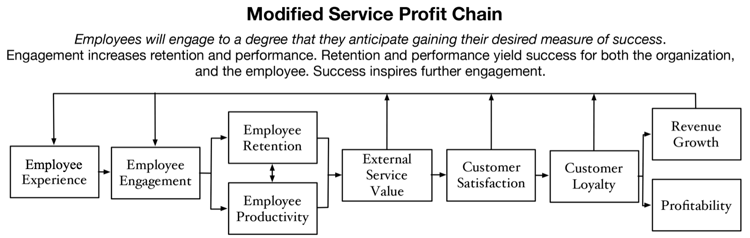
Essentially, customer experience is driven by the delivery and experience of products/services the customer deems to be valuable. If employees are not engaged/empowered to have a positive, productive experience, the products and services they build and support will also suffer. If employees do not feel connected to the mission and values implicit to their organization's brand, they are less able and motivated to deliver the external brand experience to customers. Where employees benefit from a positive experience, they are more likely to extend that experience to customers, ensuring a meaningful boost to the organization's financial success both short- and long-term.
How has people analytics technology expanded access to employee feedback?
Technology and people analytics have matured to the point where gathering employee feedback and acting on it at enterprise scale can be owned and managed by smaller teams with tight resources. As listening programs, real-time data, and analytics-driven insights become the norm, the implications for organizational performance are significant.
Mature listening programs are defined by the diversity of listening channels employed, the speed of insights analysis and actioning, integration of listening data with other business metrics, and agility to make changes as new business challenges arise. Organizations that reach this level of maturity move beyond episodic, survey-only approaches and toward continuous listening at scale, where feedback is woven into every stage of the employee lifecycle.
The average HR practitioner now has the ability to collect, store, and clean vast amounts of data in a multitude of forms pulled from disparate systems. Employee listening and acting are now pieces within a larger business ecosystem, with signals gathered across the entire employee lifecycleand connected to customer and financial data.
Combined with powerful analytical tools and the right expertise, HR and People Operations practitioners can provide relevant insights around the employee experience as a central part of strategic decision-making. The most effective teams combine survey insights with hard business metrics like attrition, performance, and productivity to prove the ROI of listening and inform decisions at every level of the organization.
Organizations that commit to data-driven, evidence-based programs to listen and respond to employee feedbackenjoy enhanced performance, market competitiveness, and healthier cultures. Yet there is still a gap between intent and impact: recent research on the state of employee listening found that only 27% of business leaders are confident their programs will help them address their key business challenges. Organizations that neglect investing in the employee/employer relationship risk wasting resources through brute-force improvements driven by gut feelings and anecdotes rather than high-quality people data.
How has HR's role as a strategic business partner evolved?
Technology has armed HR practitioners with a new set of tools for gathering, analyzing, and acting on employee feedback. While HR has always been critical in managing essential talent functions, HR teams can now deliver specific, data-backed recommendations directly to senior leaders in data-driven organizations. For HR managers who have never had an audience with the C-suite, they now arrive at the C-suite with data that connects employee experience directly to financial performance and operational outcomes.
Many organizations have developed specific functions focused on People Analytics, the data-driven approach to managing people at work. Perceptyx partners with several HR teams who are oriented toward the strategic application of employee feedback combined with objective behavioral and business metrics. As a result, those teams can now easily and quickly help senior leaders make decisions about their people based on deep analysis rather than gut feelings and relationships.The most effective teams go further by assigning clear ownership for follow-up actions and using AI-driven nudges to encourage continuous action at every level of the organization.
Frequently asked questions
What is employee listening?
Employee listening is the process of regularly collecting, analyzing, and acting on feedback from employees throughout their time at an organization. It goes beyond the annual engagement survey to include pulse surveys, wellness check-ins, lifecycle surveys, and open feedback channels that capture how employees feel at key moments. Organizations use this data to improve working conditions, prioritize investments in employee well-being, and make more informed people decisions.
What are the main employee listening methods?
The most commonly used employee listening methods include:
-
Annual engagement surveys: Broad census surveys that measure overall engagement and key drivers across the organization.
-
Pulse surveys: Short, frequent check-ins—often two to five questions—that track sentiment on specific topics in near real time.
-
Lifecycle surveys: Targeted surveys triggered by key moments such as onboarding, promotion, or exit.
-
Manager effectiveness surveys: Feedback tools that help employees rate and respond to management behaviors.
-
Open-text and always-on feedback channels: Continuous options that let employees share feedback outside of a scheduled survey cycle.
-
Most organizations use a combination of these methods to capture signals at different points in the employee lifecycle rather than relying on a single survey type.
How often should organizations run employee listening programs?
Annual surveys are no longer sufficient on their own. Most HR teams now pair a yearly engagement survey with quarterly or monthly pulse surveys to track changes in employee sentiment as they happen. Lifecycle surveys, triggered by moments like onboarding, a manager change, or a large restructuring, add another layer of targeted insight. Frequency matters, but action matters more. Perceptyx research found that only 27% of business leaders are confident their listening programs will help them address key business challenges. The gap is usually not in how often organizations survey but rather in how quickly and clearly they respond to what they hear.