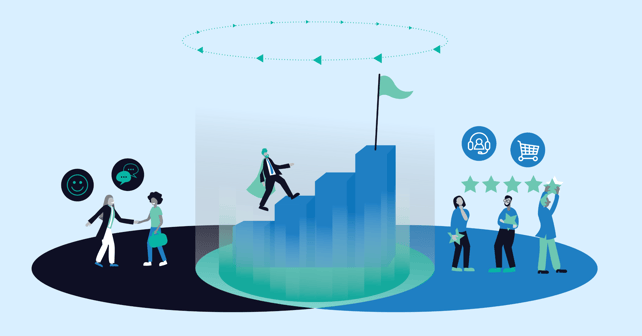
Can Better Dashboards Actually Improve Customer Experience?

Decades of research, including Perceptyx's own analyses across millions of employees, confirm that locations with stronger employee engagement consistently deliver better customer satisfaction, higher NPS, and stronger operational outcomes. The relationship is causal, well understood, and accepted by most operating leaders. So if the link is settled, why do customer experience scores at most large enterprises stay flat year after year despite billions invested in employee experience (EX) and customer experience (CX) measurement infrastructure?
The honest answer is that the field has spent the past decade solving the wrong problem. Organizations have invested heavily in collecting data, building dashboards, and improving cross-platform visibility, and most large enterprises today are well-supplied with insight as a result. What they lack is a way to translate that insight into behavior transformation and actions on the frontline, sustained over time. The relevant question is no longer "do we have the right data?" but "can we shape what employees actually do during the next thousand customer interactions?"
Why doesn't more integrated data improve customer outcomes?
The pitch for unified CX and EX data sounds compelling: a single platform, a consolidated view across the experience landscape, easier pattern recognition. While those capabilities improve visibility, they rarely translate into changes on the frontline, for two structural reasons.
First, most large organizations already operate across a fragmented technology landscape that includes CRMs, HRIS platforms, operational tools, ticketing systems, point-of-sale data, and scheduling. Adding one more central layer where experience data flows often introduces delays in the time between signal and response, leaving insights further removed from the point of action rather than closer to it.
Second, and more importantly, line managers and frontline leaders are not short on dashboards but rather on clarity about what to do differently with their team this week. A general manager at a restaurant location doesn't need another correlation between guest NPS and an engagement driver; she needs to know that her team's recognition score has dropped, what specific behavior to model in next week's pre-shifts, and how to follow up with her shift leads. Integrated dashboards, however elegant or visually stunning, do not produce that level of guidance on their own.
What does the data tell us about EX driving CX?
The relationship surfaces consistently across industries when researchers connect EX data to operational outcomes. For example, our work with a global telecom organization found that every point of increase in employee engagement corresponded to a measurable improvement in call center satisfaction and NPS. Specific behaviors, including collaboration, innovation, and commitment to quality, were direct predictors of customer satisfaction, and regions with higher engagement consistently outperformed others on customer-facing metrics.
A major restaurant chain studied across hundreds of locations found that locations where team members reported higher levels of belonging and stronger manager relationships saw better performance on customer satisfaction and key initiatives. The integration of customer survey data with employee data revealed clear, location-level patterns — a 10-point engagement difference between locations was associated with roughly 12% better customer satisfaction and 15% lower turnover — along with numerous opportunities for manager development and people activation.
In healthcare, our work has found that team members at top-rated patient sites are 11 percentage points more likely to rate patient safety as "excellent" or "very good" compared with lower-rated sites (81% versus 70%). Adequate staffing levels, trust, recognition, and belonging all predict patient willingness to recommend the hospital.
These findings are not new, but the missing piece for most organizations has been a system that can drive action based on them.
How did one hospitality operator turn employee experience insights into measurable guest experience gains?
Mohegan, the gaming and entertainment company operating premier hospitality properties globally, offers a useful case. Annual engagement data confirmed the link the company already suspected between team member experience and guest experience, and survey feedback pointed to specific places where team members could play a bigger role in shaping guest moments and where leadership communication needed to strengthen.
Rather than treating the data as a report to be published, leadership translated it into a programmatic response built around a concept called "Unreasonable Hospitality," inspired by restaurateur Will Guidara's "Hot Dog Moment" at Eleven Madison Park. The strategy asked team members to be attentive, creative, and playful in every guest interaction, and the implementation was concrete: Mohegan launched a Guest Experience (GX) Virtual Summit, an inaugural GX Week, and new recognition programs including GX Champion and Leadership Awards. Property-specific programs, such as Mohegan Pennsylvania's Extra Mile awards, gave local teams ownership.
Leadership visibility increased through targeted programs, with INSPIRE Entertainment Resort's President attending departmental pre-shift meetings and properties launching "Chief Talk" newsletters and TeamTalk video updates. The behavioral results showed up in employee participation first, with INSPIRE achieving a 96% survey response rate and Mohegan Pennsylvania's "Talk with Tony" general manager videos drawing participation from more than 60% of team members on social media. The customer outcomes followed: Niagara Casinos saw guest experience scores rise 2.8 points year-over-year. A guest testimonial from Mohegan Pennsylvania described how a security manager personally arranged dinner reservations for guests who could not secure them, illustrating what the change looked like at the level of a single shift.
In the case of Mohegan, that gain came from action on the human side, supported by an all-encompassing employee experience strategy, rather than from a color-coded dashboard offering an impressive user experience.
Why is customer experience the wrong place to start?
Customer experience data serves as a lagging indicator: a guest's NPS rating reflects an experience that already happened. By the time the score arrives in the dashboard, the team interaction that shaped it is in the past. Acting on the score helps the next guest, but only if the response system can change what employees do during the next thousand interactions.
Employee behavior, by contrast, is a leading indicator. Whether a manager runs a meaningful pre-shift, recognizes a team member for a guest moment, or addresses a recurring service breakdown determines what tomorrow's guest experiences. Organizations seeing meaningful CX gains have built systematic ways to move what their managers and frontline employees do, day to day, toward what the customer needs. That is what behavior change at scale actually looks like in practice: thousands of people moving in the same direction at the same time, reinforced until these helpful new behaviors become standard operating procedure.
What separates organizations that act from those that only measure?
Each organization discussed here started with EX data as the diagnostic and CX data as the validation, then invested heavily in the middle, where the manager and employee-level actions, the recognition mechanisms, the leadership visibility, and the targeted communications that move behavior at scale actually live.
In the telecom example, the operator socialized findings widely, ran working sessions on teamwork and innovation, and used personalized prompts to reinforce the specific behaviors the data had identified as predictors of customer satisfaction. Engagement scores improved 8 percentage points in the six months following implementation, and the CX gains followed because the underlying behavior changed.
The competitive edge belongs to organizations that can translate insight into behavior change reliably, repeatedly, and at scale — then sustain them over multiple business cycles. Dashboards and integrated datasets are useful inputs for such work, but the work itself happens at the manager and employee level, on the floor, in the moment customers actually experience.
Where should operating leaders focus first?
Three priorities emerge from our EX activation work with hundreds of leading organizations. For starters, organizations should treat EX data as the leading indicator and CX data as the validation. Customer scores tell you about last quarter's performance, while employee data signals where next quarter is heading, and the upstream signal is what should direct management attention.
The second priority concerns moving from action planning to action. A document explaining what the team should improve is not the same as a manager actually running a different conversation in Monday's huddle, or a frontline team member actually changing how she handles the next dozen guest interactions. Reinforcement in the flow of work, delivered to both managers and individual employees at the right moment, is what closes the gap. The behavioral science here is settled: field research from 2024 found that training paired with in-the-moment coaching produces durable behavior change at eight months and beyond, while training alone produces short-term change that decays quickly.
The third priority is behavior change across the entire organization. Mohegan's gains came in part from an executive involved in pre-shifts, general managers on video, and recognition programs that named the behaviors leadership wanted to see, but the bigger lever is making it easy for thousands of individual team members to know what to do, get positive reinforcement when they do it, and sustain those behaviors over time. The Mohegan Pennsylvania security manager who personally arranged dinner reservations for stranded guests is what that translates to on a single shift, replicated across thousands of such interactions.
What does this mean for your next CX investment?
The temptation when CX scores stagnate is to invest in more measurement, but the data suggests the better investment is in the system that translates what already-collected data is saying into specific, sustained changes in employee behavior. Organizations that have closed that loop are the ones whose customers feel a difference, while the rest are reading the same reports for another year.
If your team is rebuilding its EX program with customer experience improvement as the goal, schedule a working session with Perceptyx to discuss what an action-led approach could look like in your environment. For a deeper look at what the data shows about employee experience patterns and the link to operational outcomes, The State of Employee Listening 2026 report covers the structural shifts shaping the relationship between employee experience and the customer-adjacent measures most leaders care about.