
What Happens When You Link 360 Feedback to Engagement Data?

Many organizations run 360 feedback and employee engagement surveys. The 360 measures how a leader is seen by the people around them, and the engagement survey measures how a team experiences work. Read against each other, they answer a question neither reaches alone: does a leader's rated competence change the daily experience of the people who report to them?
A recent cross-survey analysis at a global professional services firm put that question to the test. The firm rated its senior leaders in a 360 survey fielded across March and April 2026, then sorted those leaders into quartiles using only the ratings others gave them, with each leader's self-score excluded from the quartile math. Those quartile groupings were added as a lens over the firm's 2025 engagement survey, so the team could see how each leader's direct reports had scored their own experience the year before. Every score below is reported as percent favorable, and the results make the case for connecting the two data sets.
What does a leader's 360 score predict about their team?
Engagement rose with the leader's 360 standing. Direct reports of leaders in the bottom 360 quartile scored 88 on the engagement index, reports of top-quartile leaders scored 92, and the two middle quartiles sat at 87 and 92. The engagement index here is the four-item Perceptyx measure of pride, advocacy, motivation, and intent to stay, which is separate from the individual survey items discussed in the rest of this analysis.
The size of that spread deserves context. Because the rated leaders were senior, their direct reports were themselves mostly mid- and lower-level managers, who tend to score higher and vary less than a broad cross-section of individual contributors. That makes the baseline high and the range narrow, so a four-to-five point lift that tracks cleanly with the leader's 360 rating is a real signal rather than noise. It also matches what Perceptyx finds across its benchmark research: employees who rate their manager as ineffective are more than six times as likely to say they will leave within a year as employees who rate their manager as effective. Overall, these results confirm employees are more engaged when they report to a more effective leader.
Which parts of the experience separate strong leaders from weak ones?
When the analysis ranked the individual engagement-survey items by how much they differed across 360 quartiles, the widest gaps clustered in one place: the relationship between an employee and their manager.
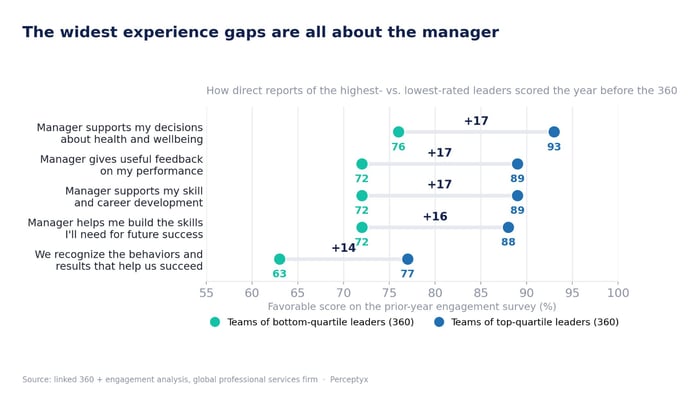
Reports of top-quartile leaders scored 17 points higher than bottom-quartile leaders (93 versus 76) on feeling supported in decisions about their health and wellbeing, 17 points higher on getting useful feedback on their performance (89 versus 72), and 17 points higher on support for their skill and career development (89 versus 72). They scored 16 points higher on a manager helping them understand the skills they will need for future success (88 versus 72), and 14 points higher on recognition for the behaviors and results that help the organization succeed (77 versus 63). The items that move most with a leader's 360 standing are the items a leader most directly controls, which is why manager effectiveness is a lever on which organizations can pull to drive improvements.
Do better-rated leaders lift the things that drive engagement?
The same pattern held for the survey items most closely tied to engagement, the drivers. These are also individual items from the broader engagement survey measuring actionable aspects of the employee experience, not the four-item index above.
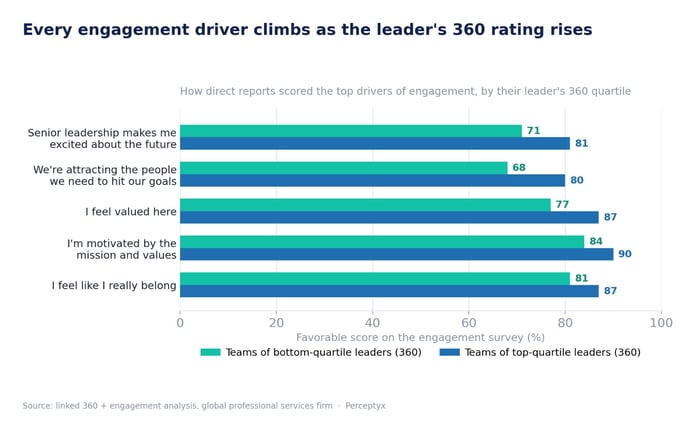
Reports of top-quartile leaders scored higher on every driver than reports of bottom-quartile leaders: 10 points higher on excitement about the organization's future, 12 points higher on confidence that the firm is attracting the people it needs, 10 points higher on feeling valued, 6 points higher on motivation tied to the mission and values, and 6 points higher on belonging.
Four of those five drivers are organizational rather than local, yet they still break down by individual leader. The mid- and lower-level managers who reported to a more effective senior leader felt more valued, more motivated, and more confident in where the organization was going.
Why read the two surveys side by side?
360 feedback shows how others perceive a leader’s effectiveness across critical competencies, while an engagement survey shows how a team experiences work. On their own, neither connects a leader’s competency ratings to the day-to-day realities of teammates’ work, or how strongly those leadership behaviors influence employees’ experiences. Linked, they did: the higher a senior leader's 360 standing, the better their direct reports' experience of useful feedback, development support, recognition, and engagement overall. The connection was clearest on the manager behaviors a leader controls directly, which is exactly where the two data sets together point development.
Reading them apart may leave such a connection invisible. A leadership team can hold a stack of 360 reports and a separate engagement dashboard and never notice that the leaders rated lowest by their colleagues are the same leaders whose teams report the weakest experience.
What can you do once the two data sets talk to each other?
Connecting the surveys turns separate reports into one set of decisions. First, you can target development at the leaders whose 360 ratings are low and whose teams report the weakest experience, rather than spreading coaching evenly across everyone. Rather than just routing these leaders back through another 360, Develop and its Live Learning Agents turn your existing leadership content into adaptive, one-on-one conversations that build those specific behaviors and score each leader's comprehension as the conversation happens, so you have proof the learning landed rather than only a completion record. Activate then reinforces the new behaviors with coaching and nudges in the flow of work, in Teams, Slack, and email, so a single learning session turns into a durable habit. You can then measure the right outcome afterward, which isn’t only whether a leader's 360 feedback score improved, but also whether their team's engagement and experience scores moved in the right direction.
Perceptyx's People Insights Model maps engagement items to the specific manager behaviors behind them, which is what makes this kind of cross-survey reading actionable. When a 360 competency, an engagement driver, and a defined behavior point at the same gap, a manager gets a concrete thing to change, and the next survey shows whether the change helped the team.
Connect listening and leadership development in one system
Both surveys already existed at this organization, but additional value came from using the same platform and then analyzing the insights together. To see how Perceptyx's People Activation System connects engagement listening, 360 feedback, and manager development in one system, schedule a demo.
For more on how organizations build multi-channel listening programs that combine engagement surveys, lifecycle feedback, and 360 input, read our 2026 State of Employee Listening report.