
What the Data Says About Healthcare Employee Experience

The Perceptyx Healthcare Benchmark Database tells two stories about 2026. Across millions of employee responses from facilities and systems, the core engagement indicators are strong. Employees continue to see healthcare as meaningful work. They are proud of what they do, they show commitment to their employer, and they attach identity to patient care and mission.
However, that steady engagement sits on top of widening fatigue. Clinical teams indicate lower belonging, weaker recognition, limited involvement in decisions, and deeper strain on well-being. Nurses remain the emotional center of the healthcare workforce, but motivation is doing a lot of the heavy lifting. Meaning keeps people committed, but the work environment is not always built to sustain that commitment.
This is not a story about disengagement. Instead, it is a story about the limits of emotional endurance in a system that still expects purpose to compensate for ever-increasing pressure.
How Strong Is Healthcare Engagement Really?
The top-line results would reassure any executive team. 82% of employees in healthcare organizations say they intend to stay with their organization for at least the next 12 months, and a similar percentage report pride in the organization. Three in four (75%) would recommend their employer as a great place to work. Additionally, more than 85% say their work gives them a sense of personal accomplishment. This is a powerful indicator in any industry, but especially in one marked by regulatory pressure, patient expectations, and staffing shortages.
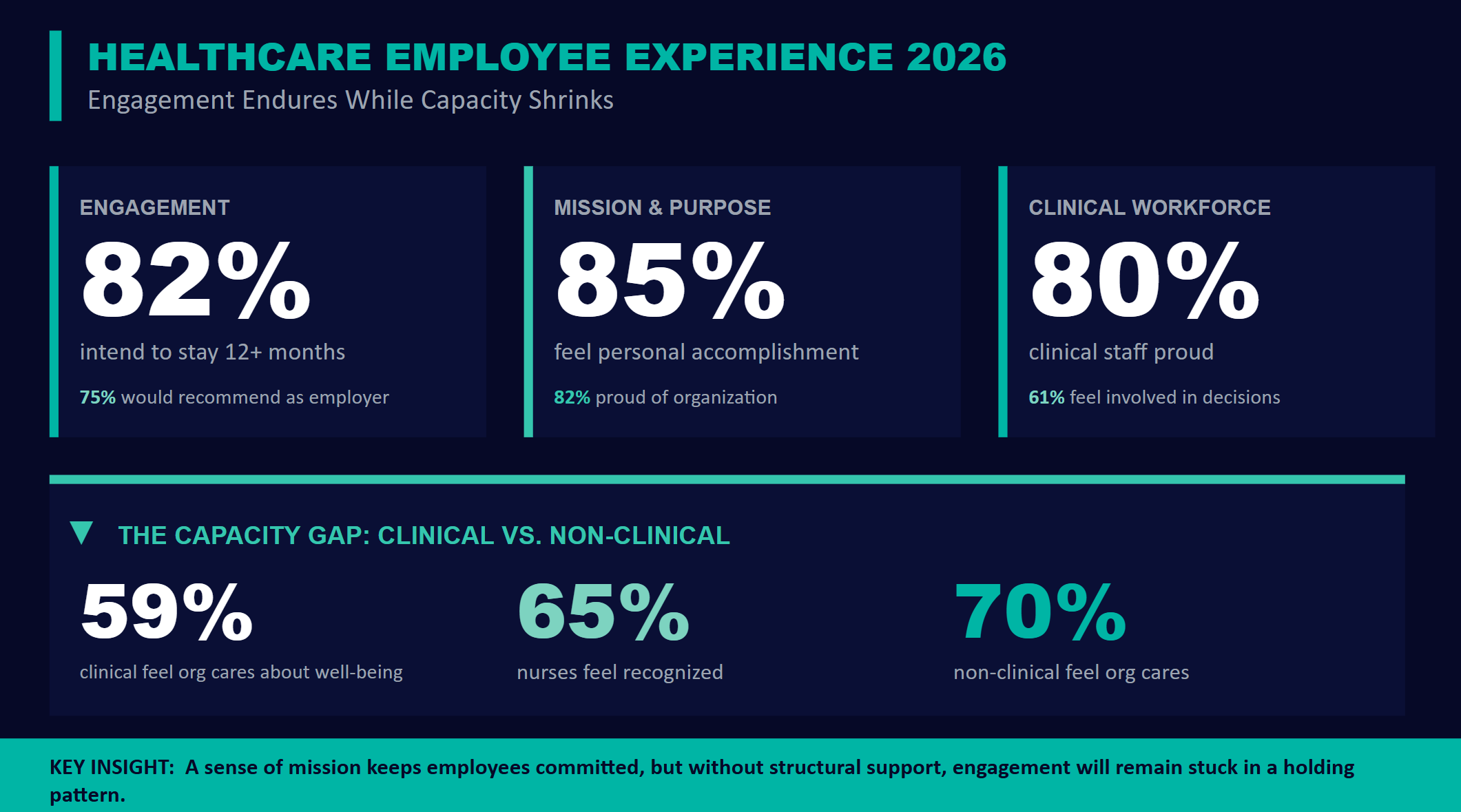
Many industries would celebrate these numbers as a sign that the employee experience is healthy. But in healthcare, advocacy sits notably lower than pride or personal intent, which signals caution. Although concerning, this issue is not unique to healthcare, and we've observed a similar advocacy gap across our broader benchmark database.
When employees want to stay but hesitate to recommend their employer, they are telling leaders: "I believe in what we do, but I am not sure it feels good to do it."
The distinction matters, because engagement as measured here is largely emotional. It reflects purpose, identity, and symbolic value. Those are durable forces, but they are also finite. If the structure of work does not reinforce them, they eventually erode. Research on healthcare employee experience confirms that hospitals with the most engaged workforces are 5x more likely to earn 4- or 5-star CMS quality ratings than their low-engagement peers.
How Do Clinical and Non-Clinical Workers Experience Healthcare Differently?
Breaking the benchmark into clinical and non-clinical roles reveals where emotional commitment begins to strain. Clinical workers score slightly lower on pride and intent to stay, but the deeper gaps exist in the mechanics of daily work. Belonging, recognition, and involvement in decisions are the pressure points.
|
Item |
Clinical |
Non-Clinical |
|
I am proud to work at the company |
80% |
86% |
|
I intend to stay with this company for at least the next 12 months |
82% |
85% |
|
I would recommend the company as a great place to work |
74% |
79% |
|
My work gives me a sense of personal accomplishment |
85% |
86% |
More than 70% of non-clinical employees say they feel appropriately involved in decisions affecting their work, compared with only about 61% of clinical employees. In an environment where workflow decisions dictate patient safety, professional credibility, and the rhythm of a 12-hour shift, a nearly ten-point autonomy gap is not simply cultural. It is operational.
Well-being is an even sharper divide. Roughly 59% of clinical employees believe their organization cares about their health and well-being, while the non-clinical workforce sits at 70%. That difference is not a matter of attitude; it reflects where pressure concentrates. The people closest to unpredictable patient volume, emotional trauma, and care coordination do not always feel the system is built to protect them.
These gaps tell us that meaning and skill are not the constraints in healthcare. Support, voice, and recovery are. Clinical engagement is powered by personal mission, but mission alone does not prevent burnout. Perceptyx research found that nursing was the most exhausting clinical position, with nearly 2 in 3 experiencing burnout.
What Does the Data Reveal About Nurses and Providers?
Inside the clinical workforce, nurses shoulder substantial emotional and operational responsibility. They report higher pride and stronger advocacy than physicians, residents, and attending providers. They want to stay, they believe in the care they deliver, and they continue to express high levels of personal accomplishment.
But motivation is not the same as thriving. Recognition sits at 65% among nurses and falls even lower for providers (58%). Involvement in decisions is similarly strained (61% for nurses and 58% for providers). While manager relationships remain a relative strength (nurses generally report strong support for skill and career development), that support does not always translate into influence over the immediate conditions of work.
The nursing results should not be interpreted as disengagement risk today. They are an early signal about tomorrow. A workforce that stays engaged because the work is a calling, not because the environment is well-designed, is a workforce operating on identity-based motivation. Identity holds. Until it does not.
Research on nurse satisfaction shows that nurses in high-performing facilities are 18% less likely to be dissatisfied and 13% less likely to experience high levels of burnout. The difference lies in system design, not individual resilience.
Why Are Belonging, Voice, and Well-Being the Leading Indicators?
Engagement scores are lagging indicators. They tell you that people still feel connected to their work. They do not tell you how sustainable that connection is. The leading indicators are voice, belonging, recognition, and recovery, and the gaps appear consistently across the benchmark.
Clinical staff trail non-clinical peers by roughly five points on belonging. On decision involvement, the gap is nearly ten. On perceptions that the organization cares about their health and well-being, the gap widens further.
Work-life balance paints a deceptively positive picture. Roughly three in four clinical employees say they can balance personal life and work. However, when asked directly whether their organization cares about their health and well-being, the answer drops below 60 percent. Employees can create balance by personal effort (childcare arrangements, shift trades, emotional compartmentalization), but the organization's responsibility is different. The question is not whether employees manage their lives. It is whether the system supports recovery.
Healthcare data on safety advocacy reveals a critical connection: healthcare workers with a strong sense of belonging are 5.5x as likely to recommend the organization as a safe place to receive care. Belonging shapes not just retention, but patient outcomes.
When purpose remains strong and organizational care feels weak, the outcome is predictable: delayed burnout, not immediate disengagement.
What Structural Actions Can Protect Healthcare Engagement?
For decades, healthcare has relied on intrinsic motivation (professional ethics, patient advocacy, emotion, and identity) as a stabilizing force. The benchmark data suggests this reservoir remains deep. That is worth preserving. However, intrinsic motivation cannot remain the primary workforce strategy.
If leaders want to protect engagement before it erodes, the actions required are structural, not symbolic.
Treat clinical well-being as a non-negotiable constraint. When staffing, scheduling, or throughput models require sustained emotional sacrifice, the model (not the employee) is the problem. Research confirms that ongoing stress and work overload lead to increased burnout and increased intent to leave, with one study finding 37% of those burnt out indicated they will leave.
Build decision involvement where care is delivered. Frontline voice improves safety, reduces rework, and protects against burnout because autonomy restores agency. Crowdsourcing employee ideas has proven effective at driving meaningful improvements in safety culture by giving clinical staff direct input into priorities.
Make recognition specific and tied to clinical outcomes. Emotional labor is part of the work; acknowledgment of that labor determines whether employees feel visible or anonymous. Research on employee experience and patient experience shows that feeling valued and recognized consistently emerge as top drivers of engagement, with most employees finding that feeling heard and having a sense of belonging have far greater positive impact than monetary rewards.
Monitor well-being as a vital sign. Healthcare organizations that treat engagement like a clinical metric, strategically managed, benchmarked, and tied to continuous action, see measurable improvements in CMS quality ratings and patient outcomes.
Healthcare is engaged because people care deeply about patients. The next challenge is whether organizations can match that commitment with system capacity. Pride and motivation are still there. But without structural support, engagement becomes a holding pattern rather than a sign of workforce health.
The question for 2026 is not whether employees care. It is whether their organizations can sustain that care without exhausting the people who provide it.
Build a Healthcare Workforce That Sustains Care
Ready to understand how clinical well-being, voice, and recognition shape your healthcare employee experience? Schedule a demo with Perceptyx to see how continuous listening and AI-powered action planning can help your organization protect engagement before it erodes.