Healthcare Employee Experience: Lessons from 2025 & Predictions for 2026

As 2026 begins, healthcare leaders find themselves navigating a landscape that is both familiar and fundamentally changed. Staffing shortages, burnout, rising patient complexity, and financial pressures remain stubbornly present. Yet at the same time, many health systems are making real progress in how they listen to, engage, and support their people.
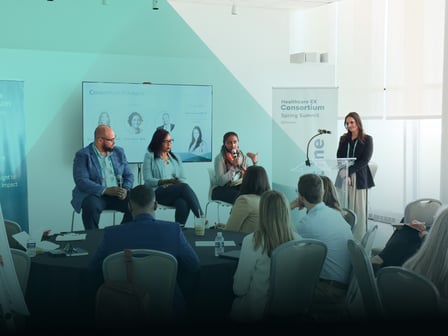
In our December session of the Healthcare EX Consortium, leaders from systems across the country came together to reflect on what they learned in 2025 — and to look ahead to the bold moves they'll need to make in 2026 to create a more sustainable, people-centered future. The conversation, based on facilitated small-group discussions rather than presentations, surfaced clear themes about wins, repeated challenges, and emerging priorities for the year ahead.
Our research shows that healthcare organizations have faced unprecedented challenges, with more than half of all healthcare employees experiencing burnout. The data is sobering: nursing remains the most exhausting clinical position, with nearly 2 in 3 experiencing burnout, while even non-clinical staff are feeling the impact, with nearly 4 in 10 registering as burned out.
When Did Listening Actually Turn Into Action?
Across organizations, leaders pointed to a similar pattern: their biggest wins in 2025 were less about launching brand-new programs and more about following through on what employees had already been telling them.
A few recurring themes that showed up in the stories shared.
More Focused Listening, Fewer Disparate Surveys
Many organizations scaled back on "survey fatigue" and instead sharpened the focus on a few priority questions tied directly to strategic goals and frontline experience. As our research confirms, there is no such thing as survey fatigue; what we have is a lack-of-action fatigue. When employees see their feedback driving real behavior change and organizational improvements, it creates a cycle of trust.
Healthcare organizations that integrate multiple listening events — combining employee experience, physician experience, nursing satisfaction, and safety culture surveys — can minimize disruption, streamline participation while gathering more actionable insights.
Quicker, More Visible Action
Where listening efforts succeeded, employees saw concrete changes: redesigned staffing models on specific units, revamped recognition practices, or improved access to mental health resources for caregivers. Our research shows that actively listening and acting on employee feedback is critical to retain and engage talent, with psychological safety being a key component.
Leaders Who Showed Up Differently
Some of the most powerful wins came from individual leaders changing their behavior: increasing their presence on units, closing the loop on feedback, and openly acknowledging the realities staff face every day. Our data reveals that 8 of 10 healthcare workers report their managers communicate openly and keep commitments, both improving since pre-pandemic levels.
The common thread: trust goes up when employees see that their feedback moves something. Even small, tangible changes made a disproportionate difference to how people felt about their organization's commitment to them.
Why Do the Same Challenges Keep Coming Back?
Despite these wins, leaders were candid about the challenges that kept resurfacing in 2025 — often the very same ones they've been wrestling with for years.
Staffing and Workload Remain at the Center
Leaders continue to hear the same message: "We're doing too much with too little." Even when engagement scores improve, the underlying strain of workload and staffing often remains unresolved. Employee belief that stress levels are manageable declined in recent years, with ability to cope with rising job stress also declining significantly.
Major drivers of burnout across the healthcare space are manageable stress levels at work, connection to the future of the organization, and a culture of safety. Organizations that address these systematically see measurable improvements.
Change Fatigue and Skepticism
Many participants noted that employees have become more cautious — and sometimes skeptical — about new initiatives. Without clear communication and proof of follow-through, even well-designed programs can be met with "We've heard this before." Recent data confirms that effective change management is now the most critical driver of employee engagement in healthcare organizations.
Middle Manager Squeeze
Leaders in the middle are carrying the weight of translating strategy into reality while also absorbing stress from both frontline teams and senior leadership. Supporting this layer — through coaching, capacity, and clarity — came through as a critical, ongoing gap. Healthcare organizations that provide targeted guidance on building psychological safety and other critical skills see measurable improvements in team outcomes.
Fragmentation Across Sites and Roles
Large systems struggle to create a cohesive experience across facilities, departments, and roles. What works in one hospital or clinic doesn't always translate elsewhere, making scale a constant challenge. Organizations need listening strategies that span the entire employee lifecycle, from onboarding through exit, to understand these differences.
One of the most powerful parts of the conversation was the shared acknowledgment that some problems aren't "fix once and done" issues. Instead, they require continuous attention, realistic expectations, and honest dialogue with employees about what is and isn't possible.
What Leadership Insights Changed How Leaders Show Up?
Participants also reflected on moments in 2025 that changed how they lead — small but pivotal shifts in perspective:
- Recognizing that transparency beats perfection: being willing to say "We don't have this solved yet, but here's what we're trying."
- Understanding that listening is a behavior, not a tool: the best "listening strategy" is often a leader consistently asking good questions and acting on what they hear.
- Moving from "owning the solution" to "co-creating it" with teams: leaders shared examples of inviting frontline staff into the design of new workflows, schedules, or recognition models.
Our research shows that employees who feel their organization cares about their health and well-being are 2x as likely to report feeling safe to openly express their opinions. This psychological safety forms the foundation of workplace well-being and innovation and can serve as a hedge against the sort of extreme burnout analyzed in some of our earlier healthcare research.
These insights suggest that, while large-scale organizational changes matter, the day-to-day experience of leadership — how leaders communicate, respond, and show up — continues to be one of the most important levers for employee experience. The link between employee experience and patient experience is well-established, with safety culture, recognition, and collaboration as primary drivers.
What Bold Moves Are Healthcare Organizations Planning for 2026?
In the forward-looking portion of the session, leaders were invited to consider: What's one bold move you're considering for 2026? Several ideas rose to the surface.
Reimagining Roles and Career Paths
Rather than incremental tweaks, some organizations are exploring entirely new models for nursing, care teams, and support roles — creating clearer pathways for growth and more flexible roles that align better with different life stages. Data shows that employees who are not experiencing symptoms of burnout are significantly more likely to stay, while those experiencing burnout are more than 3.5x as likely to consider leaving the industry entirely.
Doubling Down on Psychological Safety and Voice
Many leaders want 2026 to be the year they move beyond "we ran a survey" and into sustained, structured forums where employees can safely challenge, question, and contribute to change. In psychologically safe work environments, workers can openly voice opinions, identify mistakes, and ask for feedback without fear of negative consequences — a critical component of organizational resilience.
Treating EX as a Strategic Vital Sign
There's growing recognition that employee experience isn't just an HR initiative; it is tightly tied to quality, safety, and financial performance. Leaders discussed embedding EX metrics directly into operational dashboards and leadership incentives. Healthcare organizations excelling in leadership development, safety culture, and valuing employees are able to provide more positive patient experiences through highly engaged workforces.
Investing in Manager Capability at Scale
Several organizations are planning significant investments in leader development — particularly for middle managers — focused on coaching, communication, and leading through change. AI-powered solutions can provide personalized coaching that builds the exact skills teams need, creating a continuous learning experience embedded in daily work.
Underlying all of these ideas is a shared belief: the status quo is no longer sufficient, and the organizations that will thrive are those willing to experiment, learn quickly, and involve their people every step of the way.
What Are Healthcare Employees Really Asking For?
Even without seeing each organization's specific data, participants agreed that employees' messages are increasingly clear:
- "Help us do great work without burning out." When employees feel that change is managed effectively, they are 1.7x as likely to feel they can manage their work stress.
- "Be honest with us about what's happening and why." Transparency in communication builds trust and engagement, even when the news isn't perfect.
- "Invest in us — not just today, but in our future here." More than 90% of healthcare workers have a clear understanding of their company's mission, but they need to see how their development connects to that mission.
- "Make sure our leaders are aligned and equipped, not just promoted." Leadership development can't be a one-time event but must be continuous, connected to real feedback, and ideally scalable organization-wide through the use of agentic AI.
For consortium members, 2026 will be about responding to those messages with courageous listening, visible action, and sustained commitment, rather than one-off initiatives.
What Does This Mean for the Future of Healthcare?
The December session underscored that healthcare organizations are facing many of the same headwinds — but they're also testing creative, human-centered ways to respond. By continuing to share what's working (and what isn't), these leaders are helping shape a future where employee experience is treated not as a "nice-to-have," but as a core driver of patient care and organizational performance.
Our data shows a widening gap in employee engagement, with the gulf between the most engaged healthcare organizations and the rest continuing to widen. This suggests urgent action is needed by most healthcare systems to improve the healthcare worker experience.
The real bold move for 2026 may simply be this: refusing to treat employee experience as separate from the business of healthcare — and building systems where caregivers can truly thrive. As our research consistently demonstrates, EX affects the tangible and intangible elements of an entire organization, increasing profitability, innovation, and performance through its ability to attract and retain the best talent.
Ready to Make Your Bold Move for 2026?
Perceptyx's comprehensive healthcare solutions help you move from insights to action, with tools designed specifically for the unique challenges of healthcare. Become a member of the Healthcare EX Consortium to learn how leading health systems are using data-driven insights to reduce burnout, strengthen psychological safety, and build sustainable cultures of excellence.